A Cold in the Desert

My efforts to keep up with the pace of China may have been a little too much for me.  I went to bed last night with a tickle in my throat, and woke up this morning with a full-blown head cold.  I guess it was fortunate that I didn’t get a train ride out of here today, because I was able to spend most of the day in bed, trying to recover as quickly as possible.  Despite being occasionally awakened by persistent chambermaids trying to clean the room (evidently the “Do not disturb” sign is just for show), I was able to get a lot of rest today, but I still feel pretty bad.  Hopefully, I’ll feel better by tomorrow, when I have an epic 30-hour train ride to Kashgar.

I made it out late this afternoon to get some soup for dinner.  The temperature climbed to 105 degrees today, and it was still pretty hot when I went out at 7:30 (Beijing time, which would be 5:30 if the country were not all on the same time zone).  I can’t remember if it’s good to sweat out a cold, but I gave it some effort.  Turpan is in China’s Death Valley, and is at the second lowest elevation in the world (behind the Dead Sea), which makes it incredibly hot.  Unlike Death Valley, however, this is an oasis, so there is water.

I was feeling pretty stuffed up and pretty down when I was wandering around the bazaar, trying to find something to eat that wouldn’t make me feel worse, when a kindly old Uighur gentleman, named Abdullah, invited me to sit next to him.  He insisted that I take a kabob from him, and then he ordered me up some soup with noodles and beans.  Surprisingly, it was exactly what I needed.  I thanked him profusely in extremely broken Uighur, and he was on his way.

Here are some photos that I took from my excursion:

For those of you who wondered what breakfast is like in China, this is what it looks like at this hotel (not representative of the rest of China).

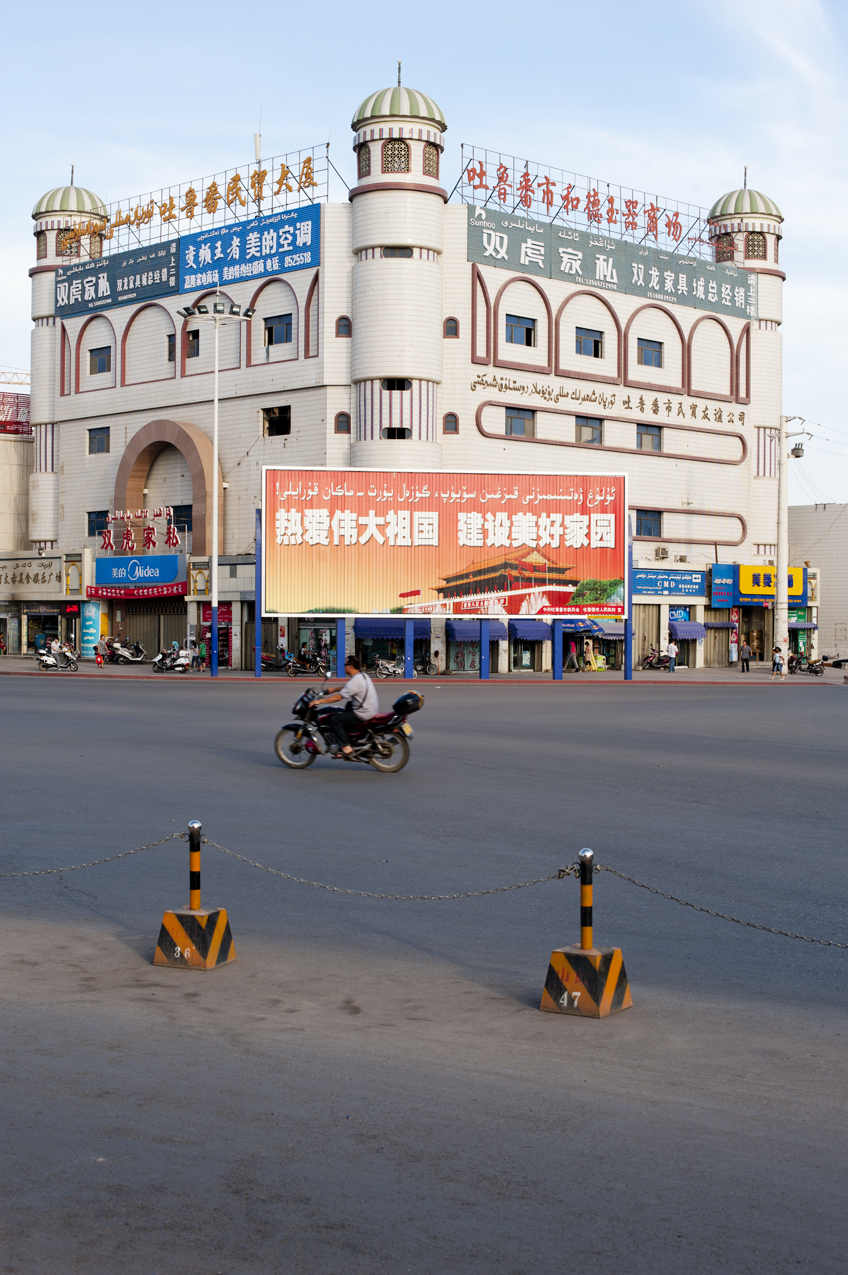
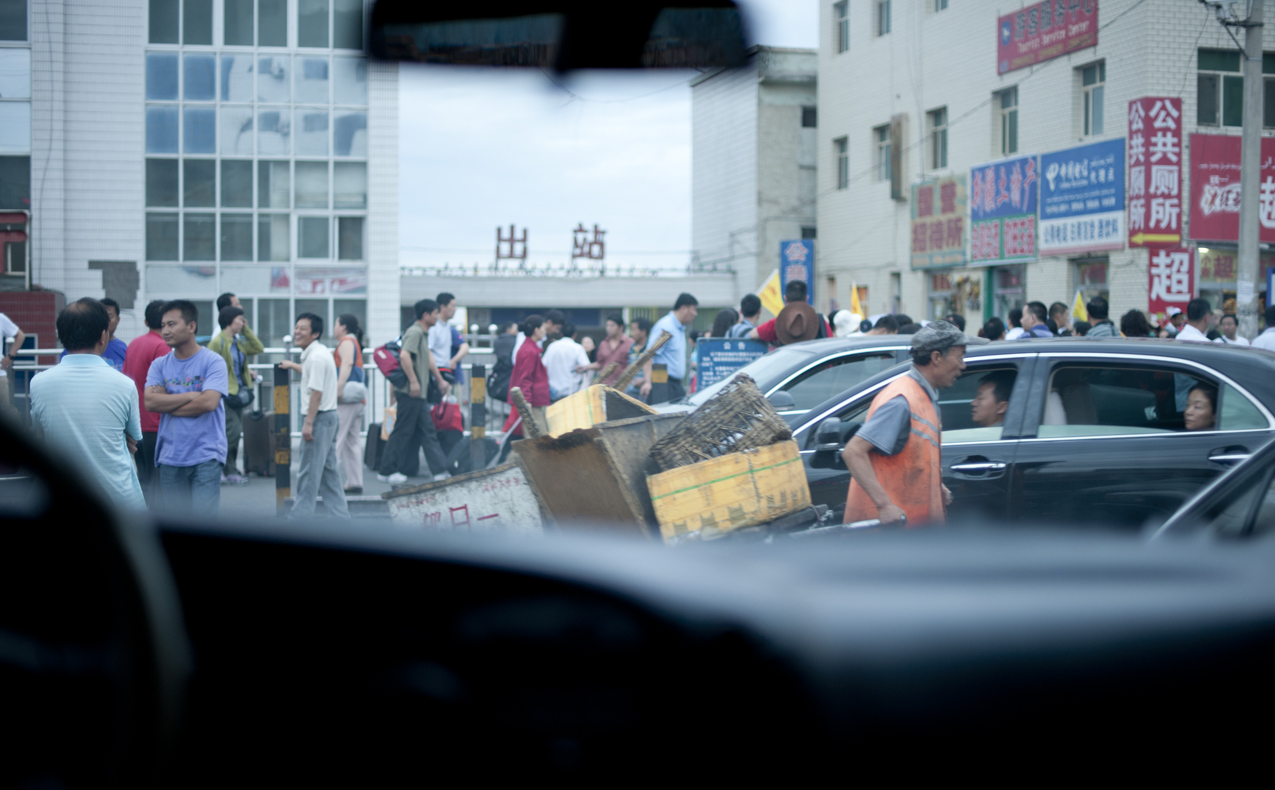
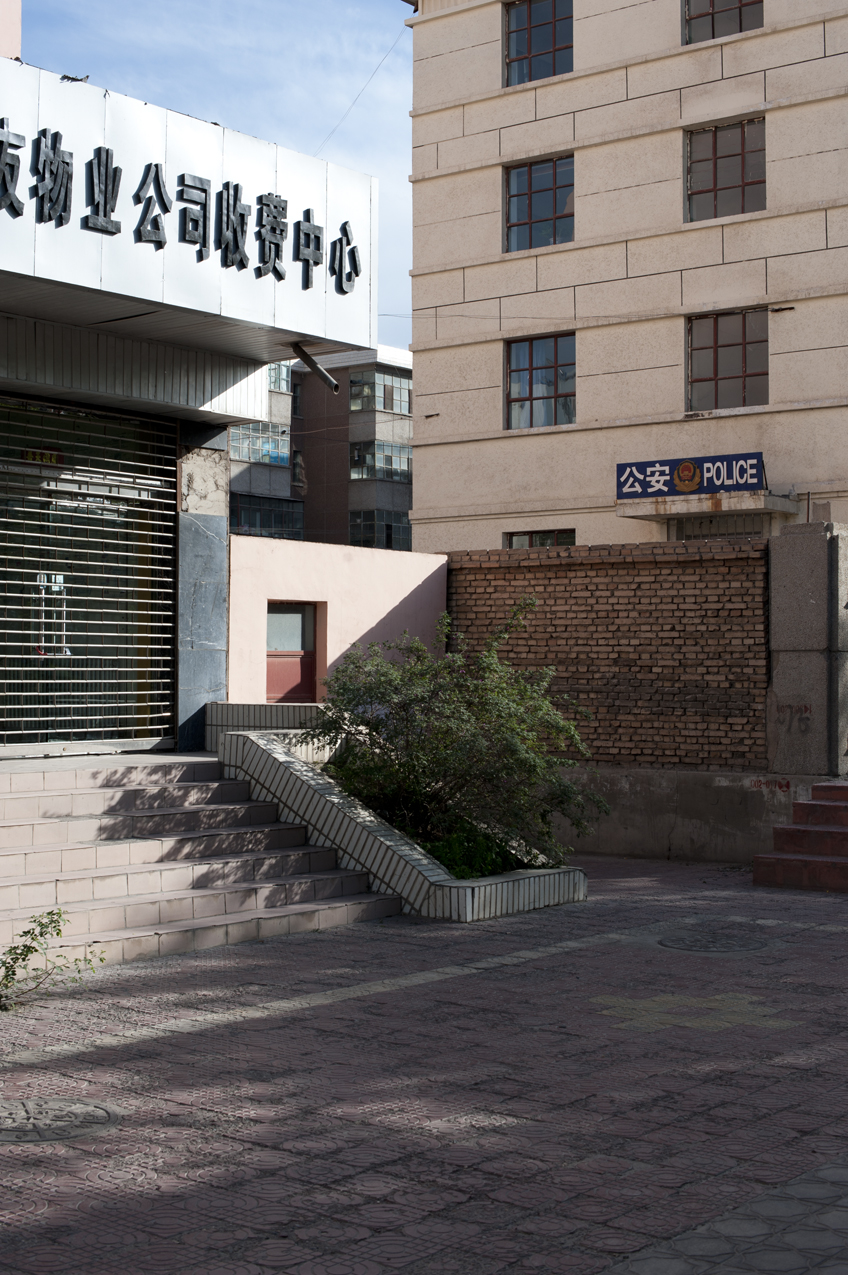
All the signs in this region are in both Uighur and Mandarin.

A balloon to brighten your day?

Yes, the bazaar does sell carpets.

You can also find every kind of nut or dried fruit imaginable.

My dinner is prepared.

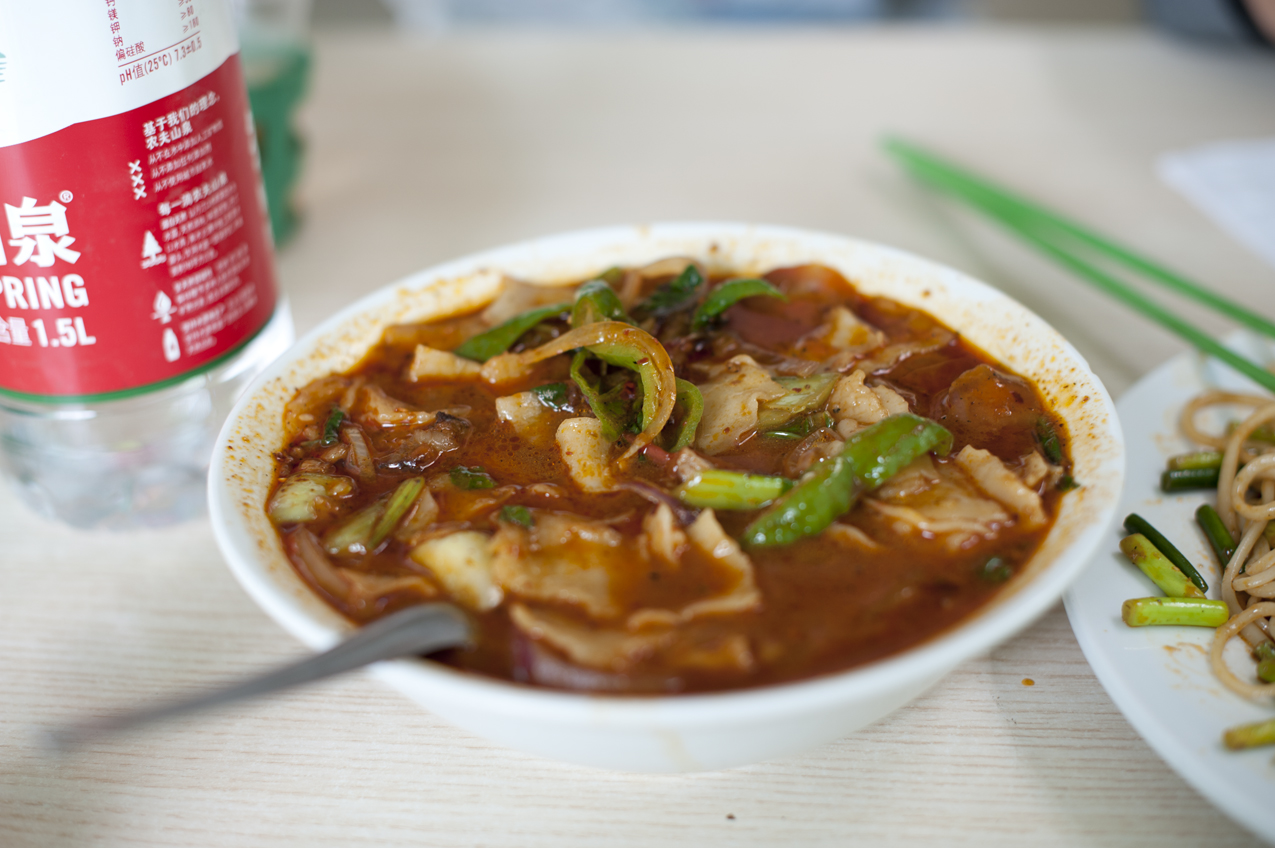
My dinner: soup with noodles and beans for my cold. The beans were a challenge to eat with chopsticks, considering that I couldn't see them through the broth.

Uighur nan is terrific. It's made in a special kind of wood-burning oven, and gets its flavor from scallions.

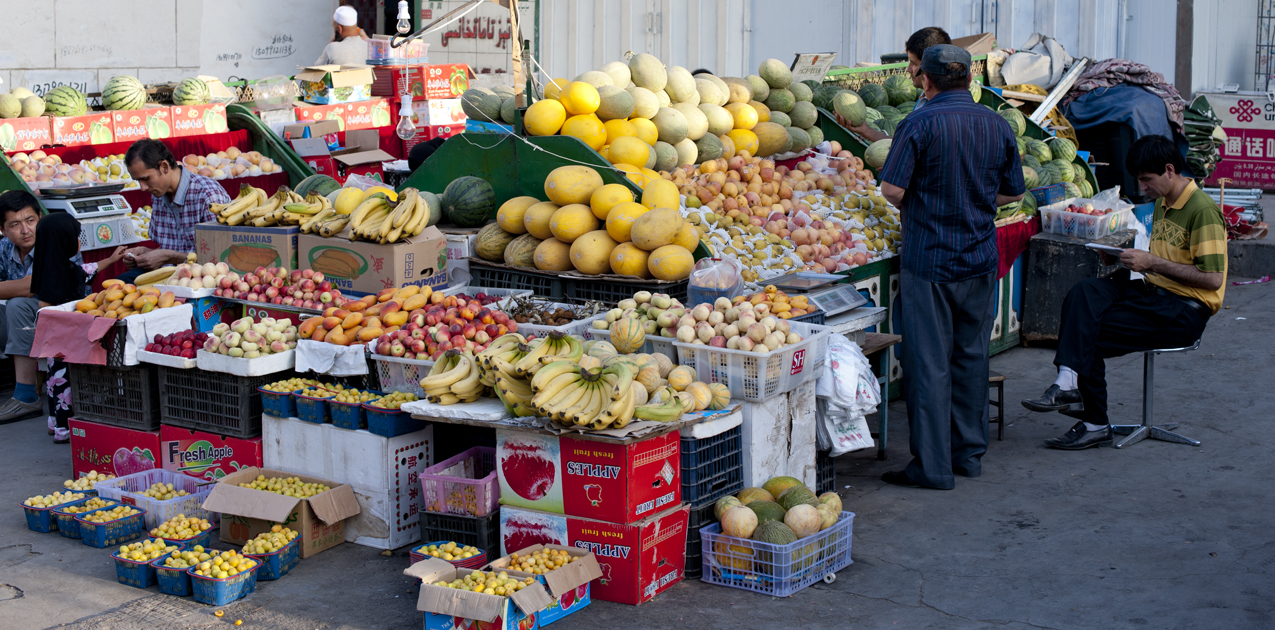
There is never any problem finding fruit in this part of the world.

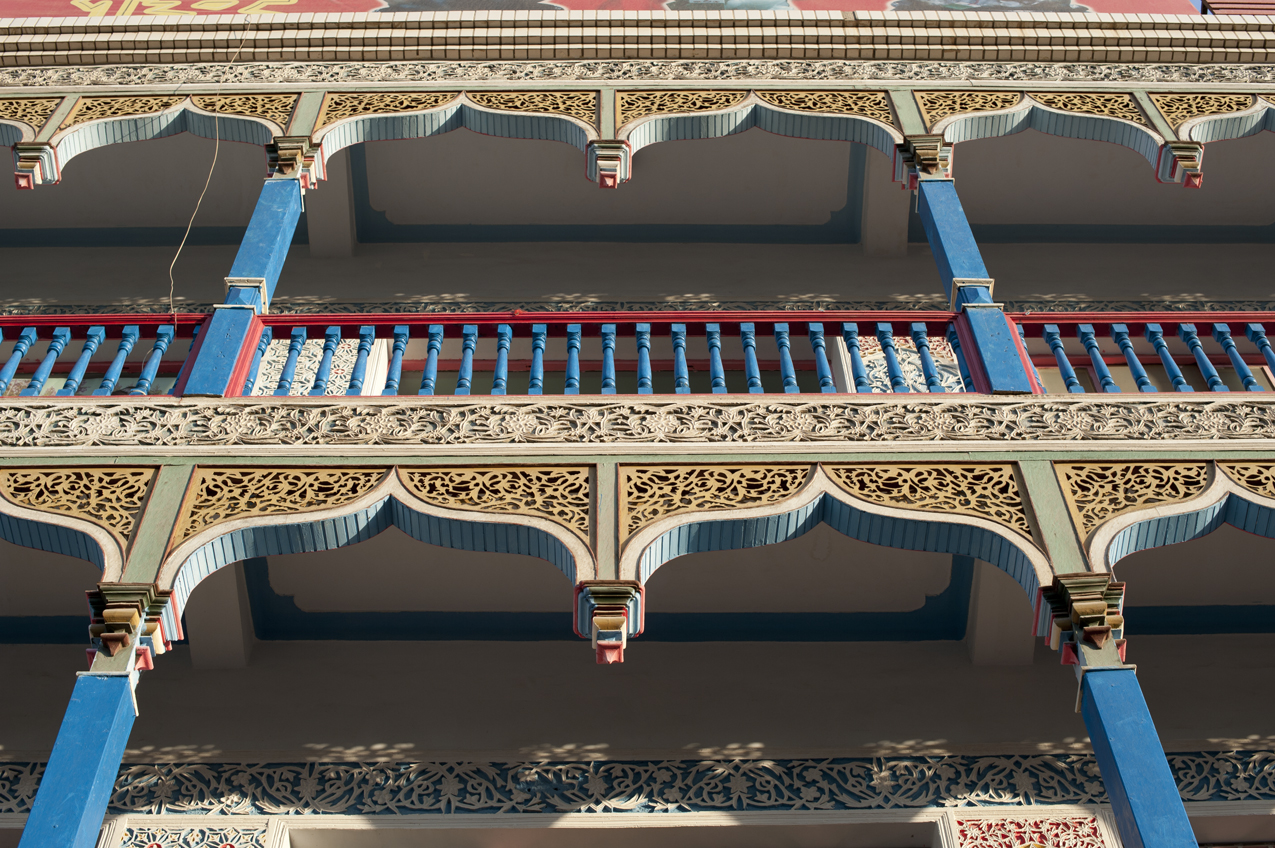
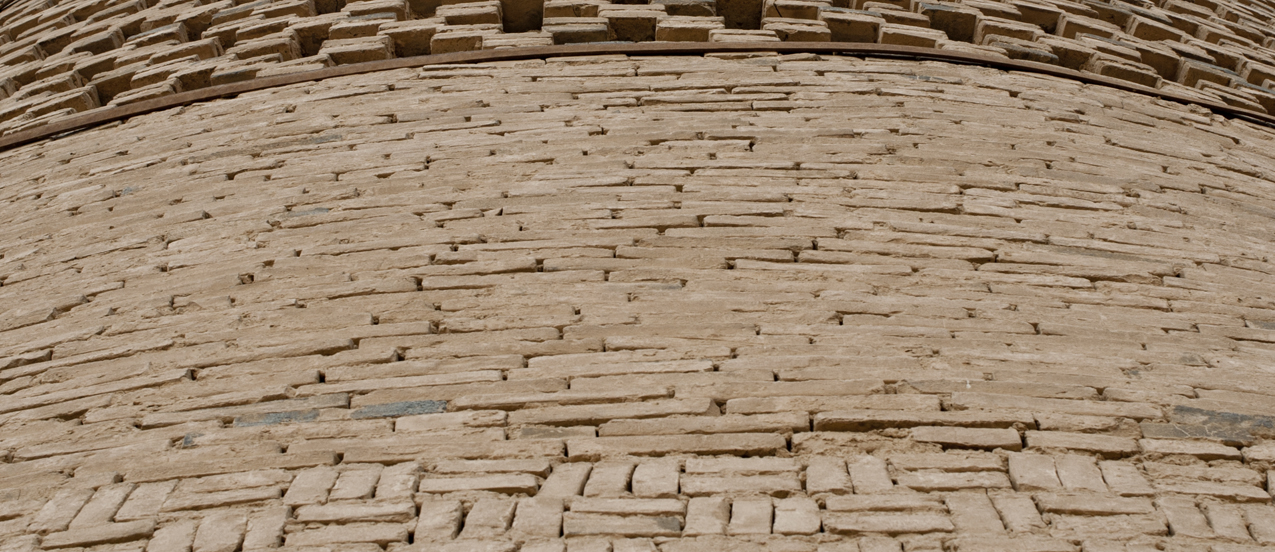
This level of ornamentation shows up everywhere in buildings that were built more than 20 years ago.

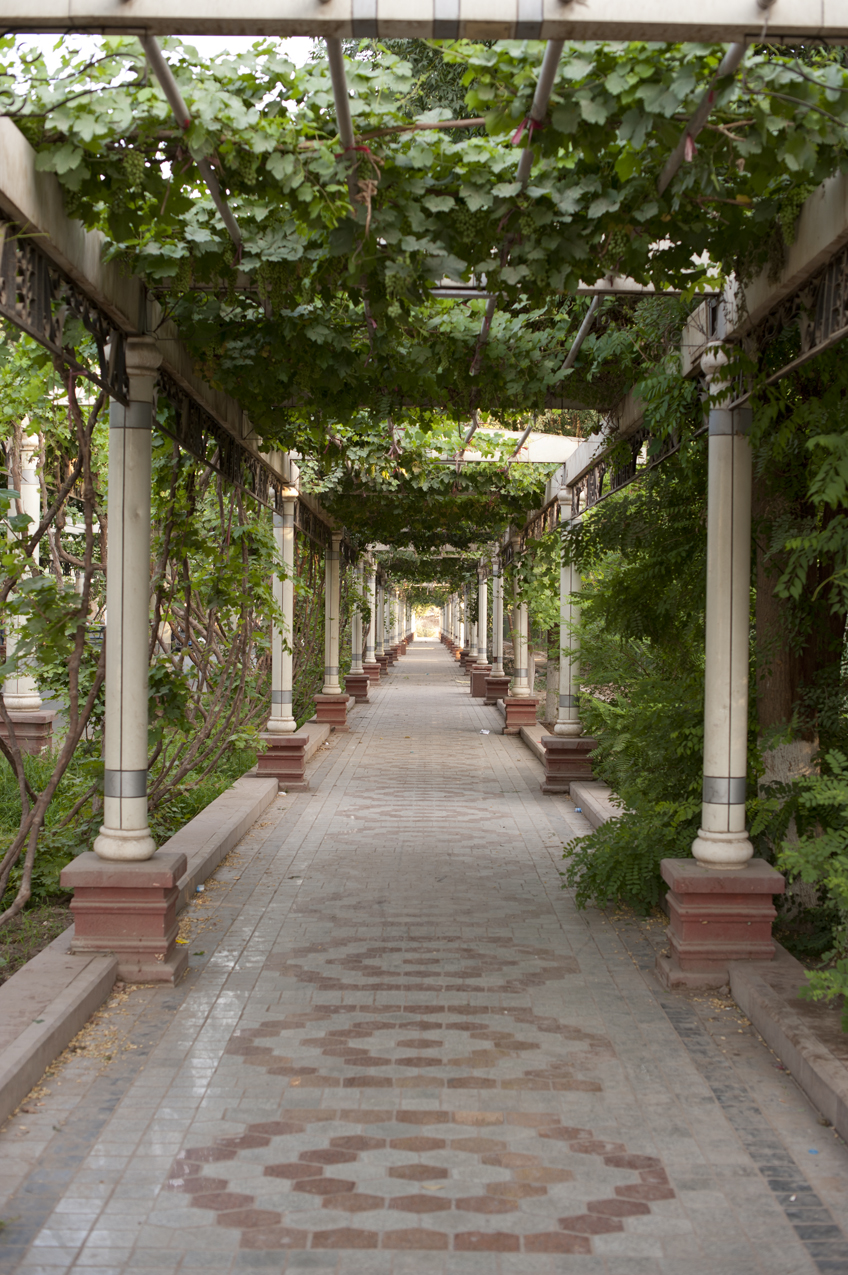
Turpan is full of these grapevine-covered streets. On hot days like today, it's noticeably cooler under here, and deliciously fragrant.


Hospitality-Land

It’s been a long and grueling couple of days, but I’m safely enjoying my air-conditioned room in Turpan.  Unfortunately, although I had hoped to head on to my next destination, Kashgar, tomorrow, I have not been able to get a ticket on the one train that goes there.  In China, you cannot book a train ticket in advance from another city.  You actually have to be in the city from which the train is departing.  As a result, I’m stranded here for at least another day, staying in a luxurious hotel by Chinese standards (the only one in town that wasn’t booked).

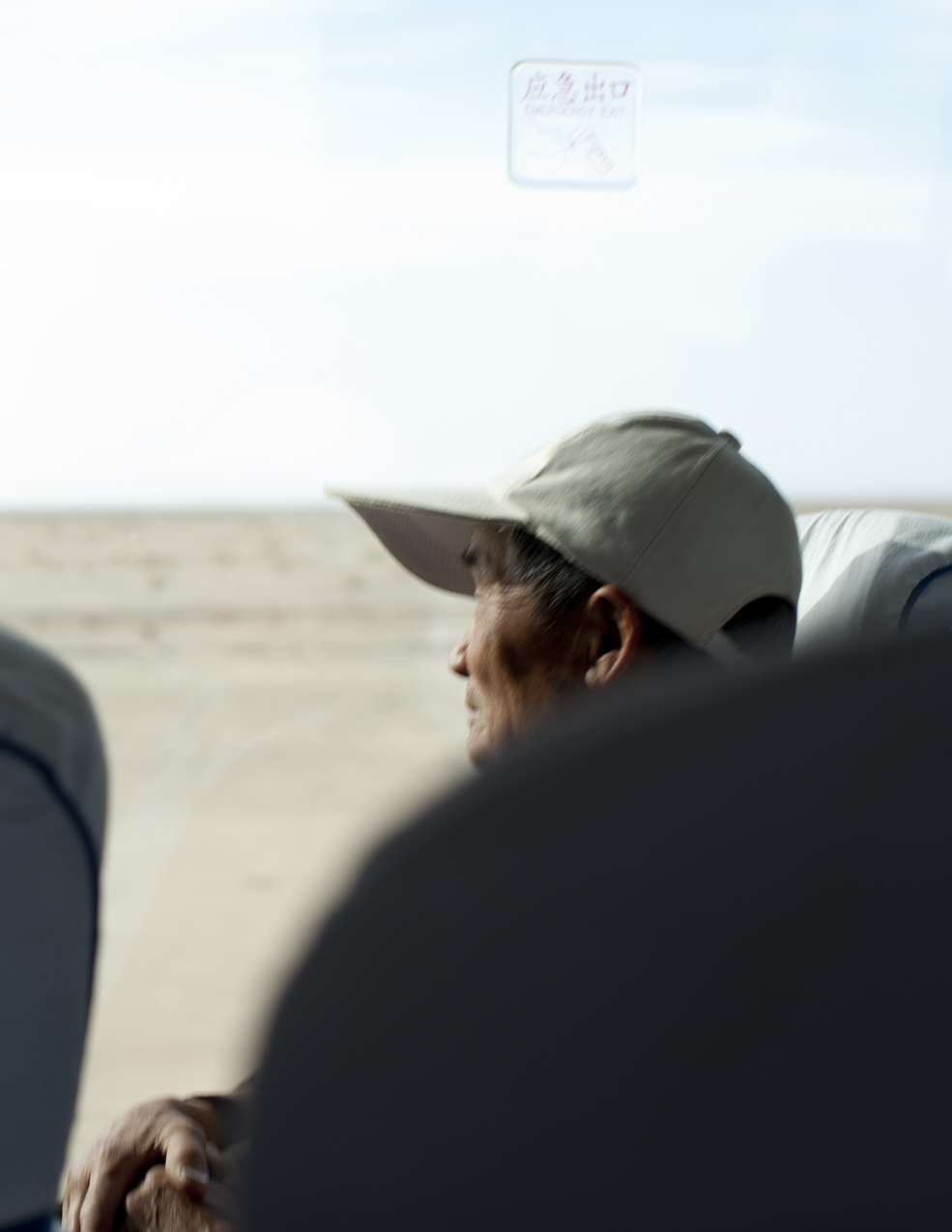
My trip here was eventful.  I left Dunhuang yesterday evening in a shared cab to the train station, two hours away, straight through the desert.  As we got going, the other three passengers, all old chinese men, immediately fell asleep.  I had the fortune of riding in the middle seat in the back, from where I made direct eye contact with the driver through his rear-view mirror.  Just outside of town, we almost hit a wild bactrian (two-hump) camel.  A bunch of them had been resting on the side of the road, and one suddenly darted (as much as a camel can be said to have “darted”) into the center of the road.  My cab driver, who didn’t seem phased, just stepped on the gas in hopes of squeaking by the massive beast.  We barely made it, and I could hear the camel grunting furiously through our open windows.  By the way, I didn’t even know that there still were wild camels.

As we moved out into the harsh desert, I began to notice, in the rear-view mirror, that my driver was struggling to stay awake.  He kept trying to force his eyes open, but as soon as he did, they began to droop again.  Since nobody else in the car was of any help, I made it my duty to kick his seat every time I saw his head bow.  Eventually, after about 45 minutes of kicking his seat, and after he stopped to relieve himself on the side of the road, he seemed to snap out of it, and we were moving straighter towards our destination.  The landscape quickly changed from yellow sand, to completely barren black sand, which is supposedly rich in iron ore.  It was the most desolate landscape that I have ever seen, even in photographs (unfortunately, I don’t have any of it, as I was crammed between two sleeping men in the back seat of a speeding Volkswagen).  Eventually, we made it to the crowded train station, where I had an hour to lounge around with two thousand other people before my train arrived.

This train was completely different than the sleeper train on which I travelled before.  Rather than separate rooms filled with bunks, they were all just open.  Needless to say, my feet didn’t fit in the bed, and I had to pull them in, or people would hit them as they walked down the aisle.  It was a rough night, but I got through it, and arrived at the train station in Turpan, which is an hour away from town, at 6:30 this morning.

My guidebook suggested taking a mini-bus to town, saving a lot of money.  Unfortunately, though, the mini-bus drivers don’t leave until their cars are completely full, and I guess nobody else needed to go in my direction, because we sat at the train station for an hour and a half, waiting for more people as each train pulled in.  Maybe people thought I smelled (I was on a train for ten hours), because nobody got in.  Finally, I gave up, and just took a cab to town, which set me back $20 (the mini-bus would have cost me $1.25).

All in all, though, today was a really good day, and I met some great people.  I spent time exploring the town on foot, and then the surrounding area by cab.  Although I’m still in China, I feel like I’m in a completely different country.  The pictures are below.  Remember that you can click to enlarge them.

A bean dish with hot peppers in Dunhuang
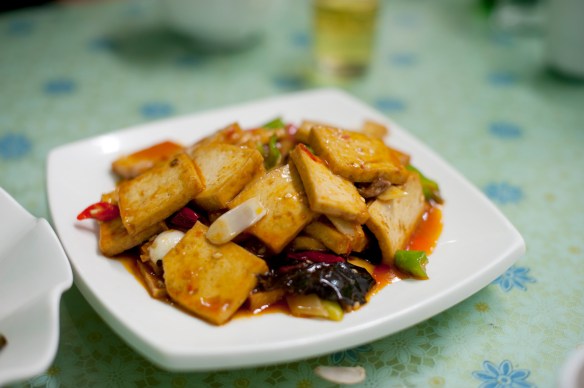
Sauteed Tofu

Hand pulled noodles with vegetables and meat, a local specialty.
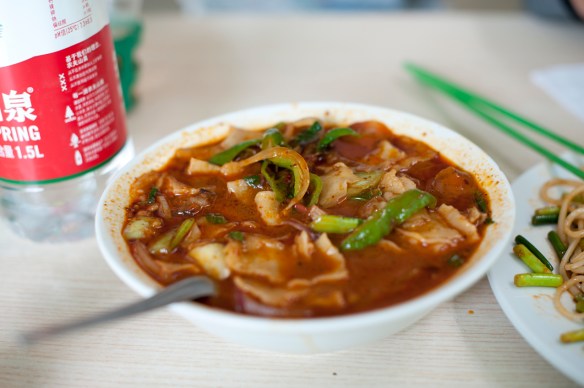
Cut noodles Xinjiang-style. The cook holds a block of pasta dough over the wok, and quickly cuts off slices into the pot. It makes a rustic noodle that's delicious.

This was the view that I enjoyed for about an hour and a half this morning as I waited for my minibus from the train station to town to fill up. Eventually, I just gave in and hired a cab for the 1-hour trip, which set me back $20.

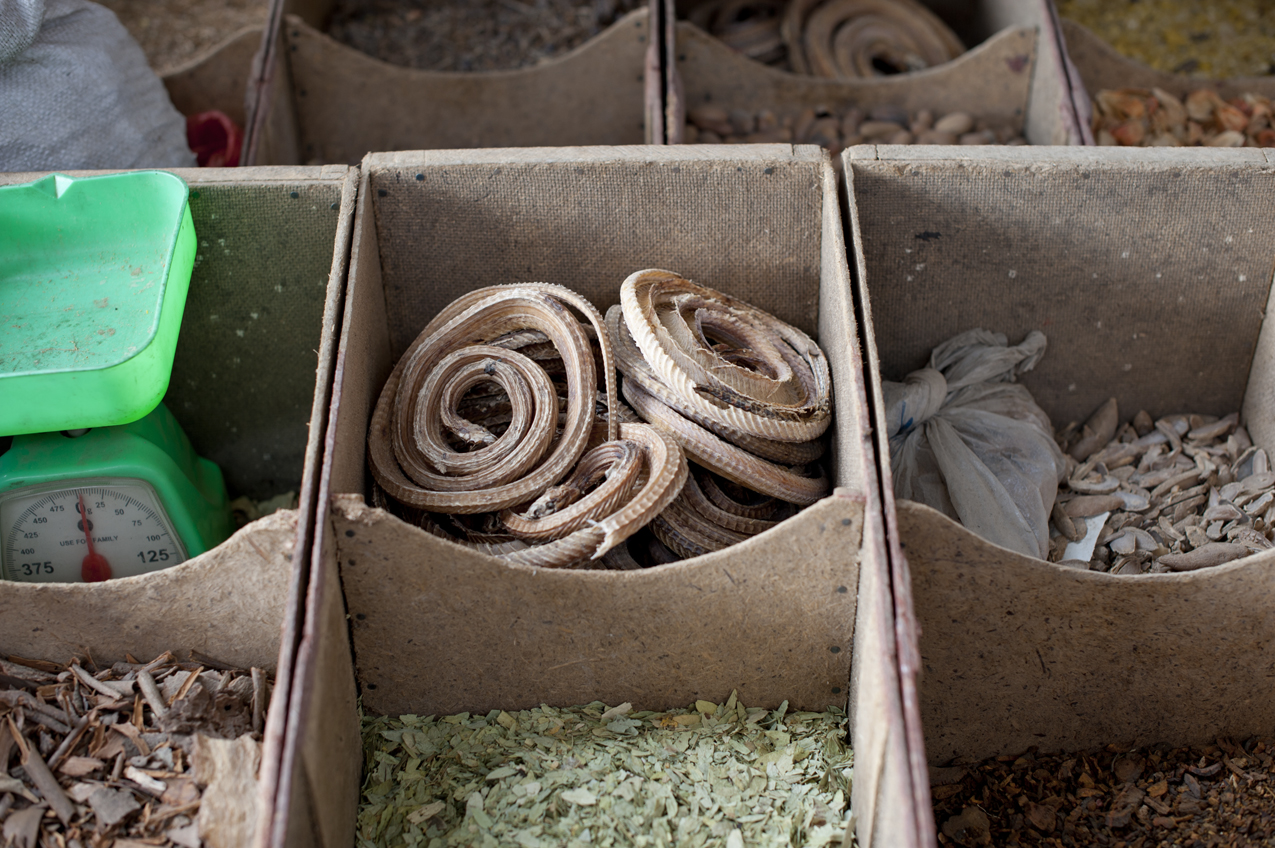
Anyone care for some medicine from the Bazaar?
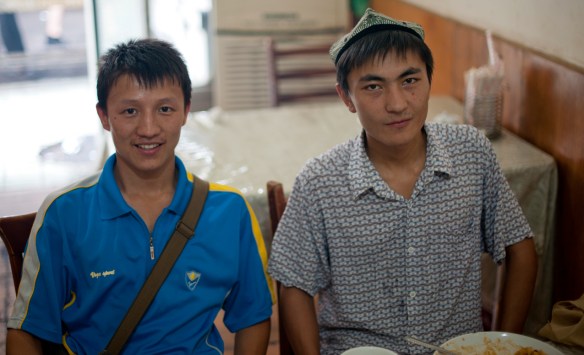
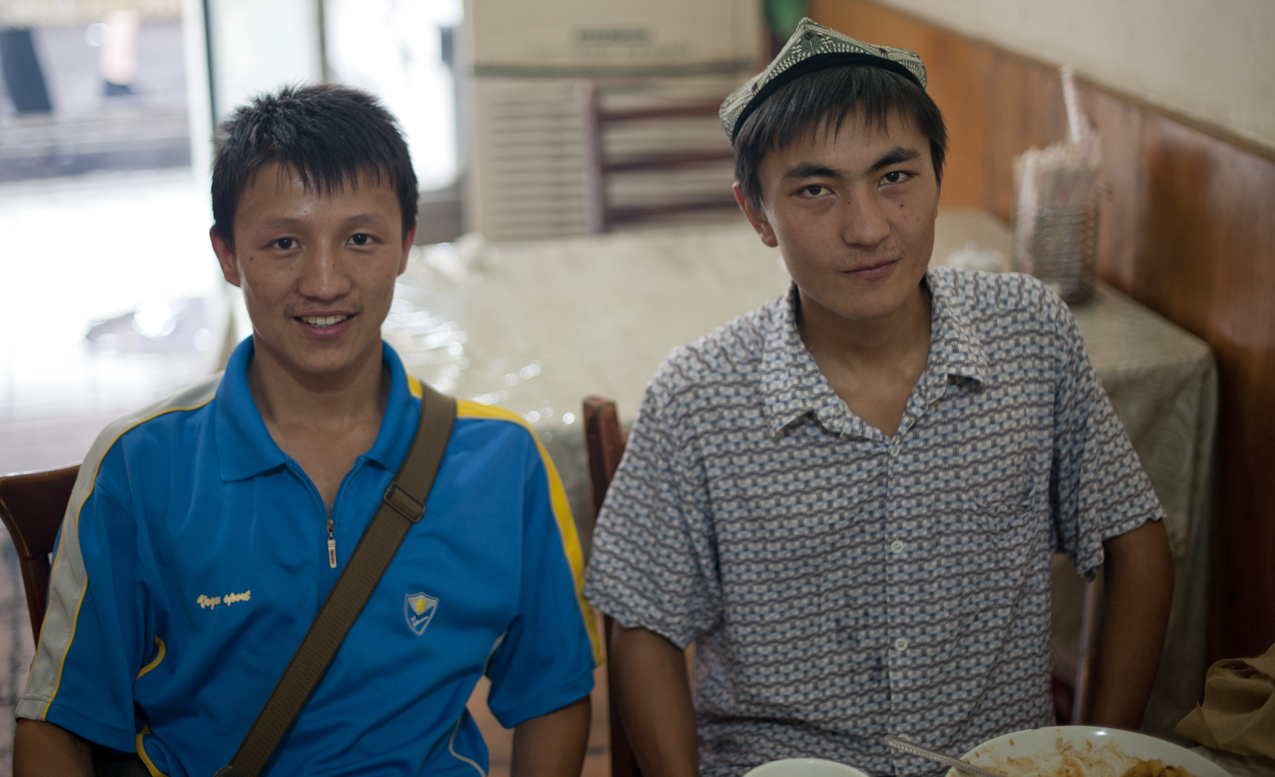
My two Uighur friends. These two guys approached me as I was wandering around town. They were trying to practice their English, and they took me to one of the best food spots in town. They were truly great friendly guys who asked for nothing in return for showing me around the city.
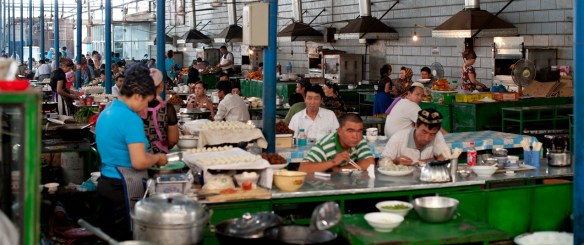
The food stalls at the bazaar.

The delicious meal that my Uighur friends ordered for me. It was coarsely cut noodles with sheep, beans, hot peppers, cilantro, and loads of garlic.
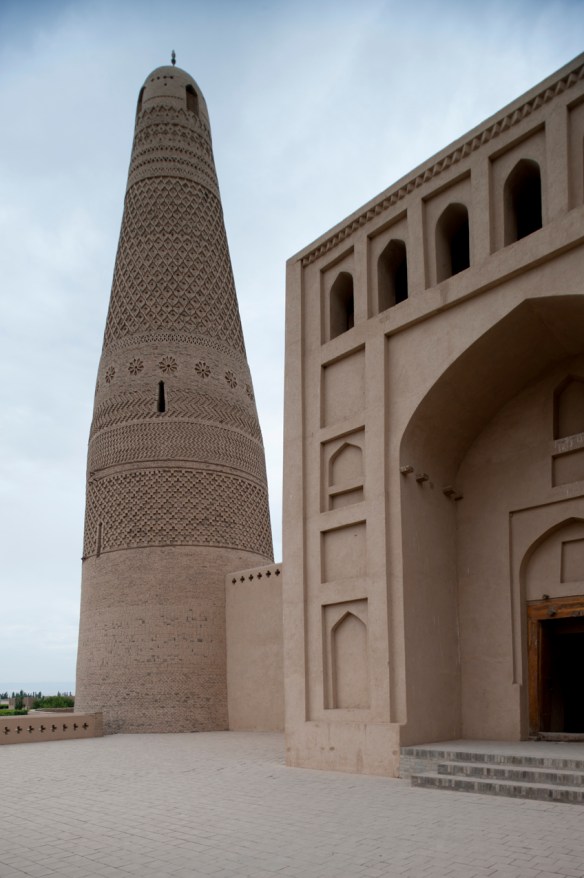
The Emin Minaret and the attached Mosque. I've certainly come a long way from Xi'an.

The interior of the mosque - sort of "Get Smart"-ish

My cab driver decided to take me to his house to pick up his sister so that she could accompany us to the sites around town. These are his goats.
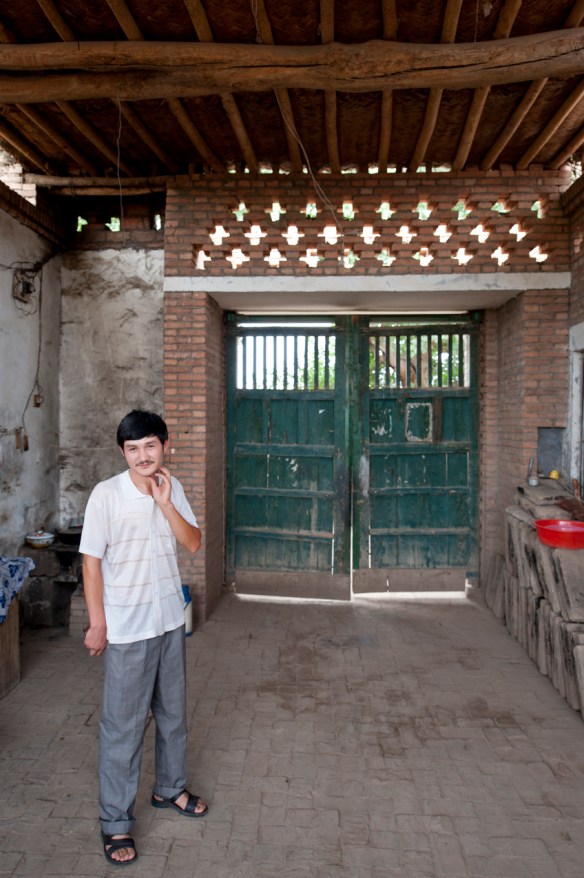
My proud cab driver in the courtyard to his family house. He is 21, and studied English in Urumqi before buying his own cab.
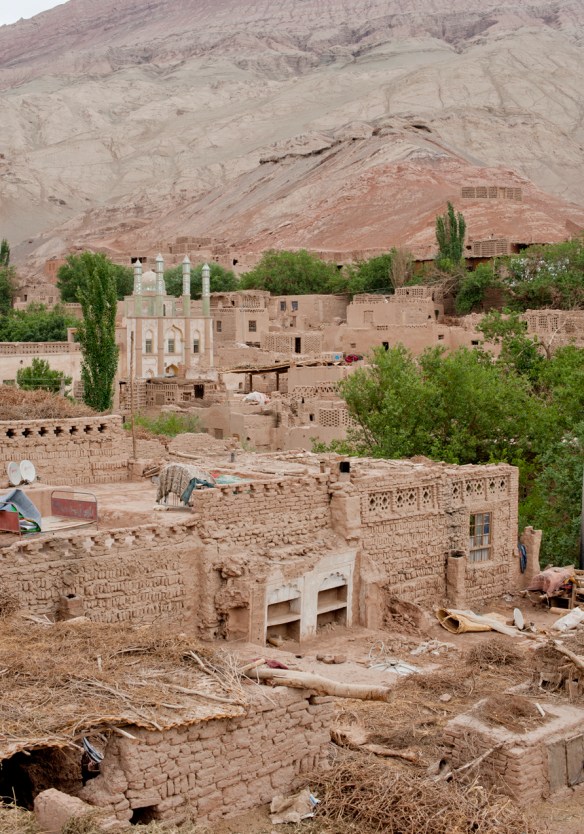
Tuyoq, an ancient city that is still fully functional, despite the fact that it is a minor tourist attraction.
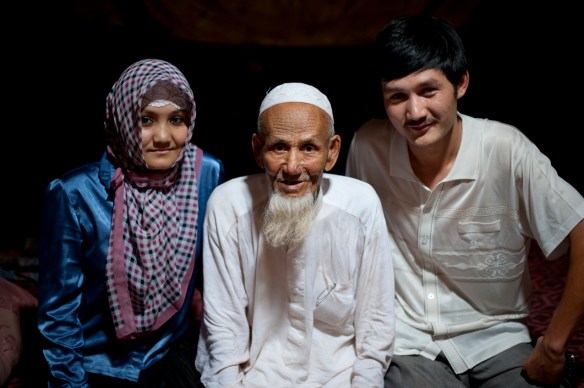
A friendly 100-year-old man, who insisted that I take his picture as he showed me around his 500-year-old house. My cab driver and his sister flank him.

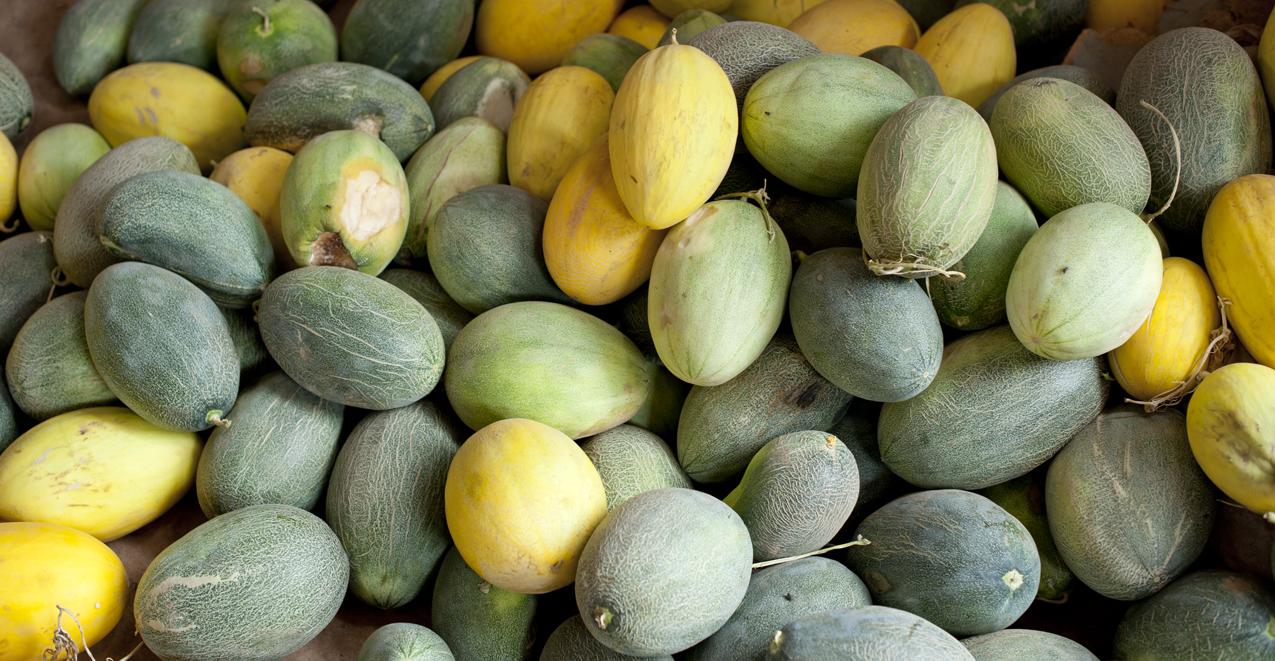
The 100-year-old man's stockpile of melons. This region is very famous for both its melons and its grapes. The man insisted that I take one.

Much to everyone's lament, the melon was not good. The old man, embarrassed, insisted that we take another one. It was also not even remotely ripe. I ate it in front of him, not wanting to offend him, though.

The Tuyoq Mosque

I wasn't allowed inside. this was the best view that I could get.
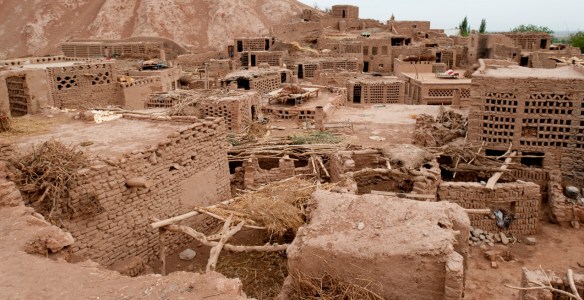
Tuyoq reminds me of some storybook version of a Middle-Eastern community. People put beds on the roofs during the summer to take advantage of the cooler nights. The lattice brick work is used to bring in natural ventilation, and the rooms that it encloses are also used for drying grapes. This region is very famous for its grapes and raisins.

Tuyoq at street level

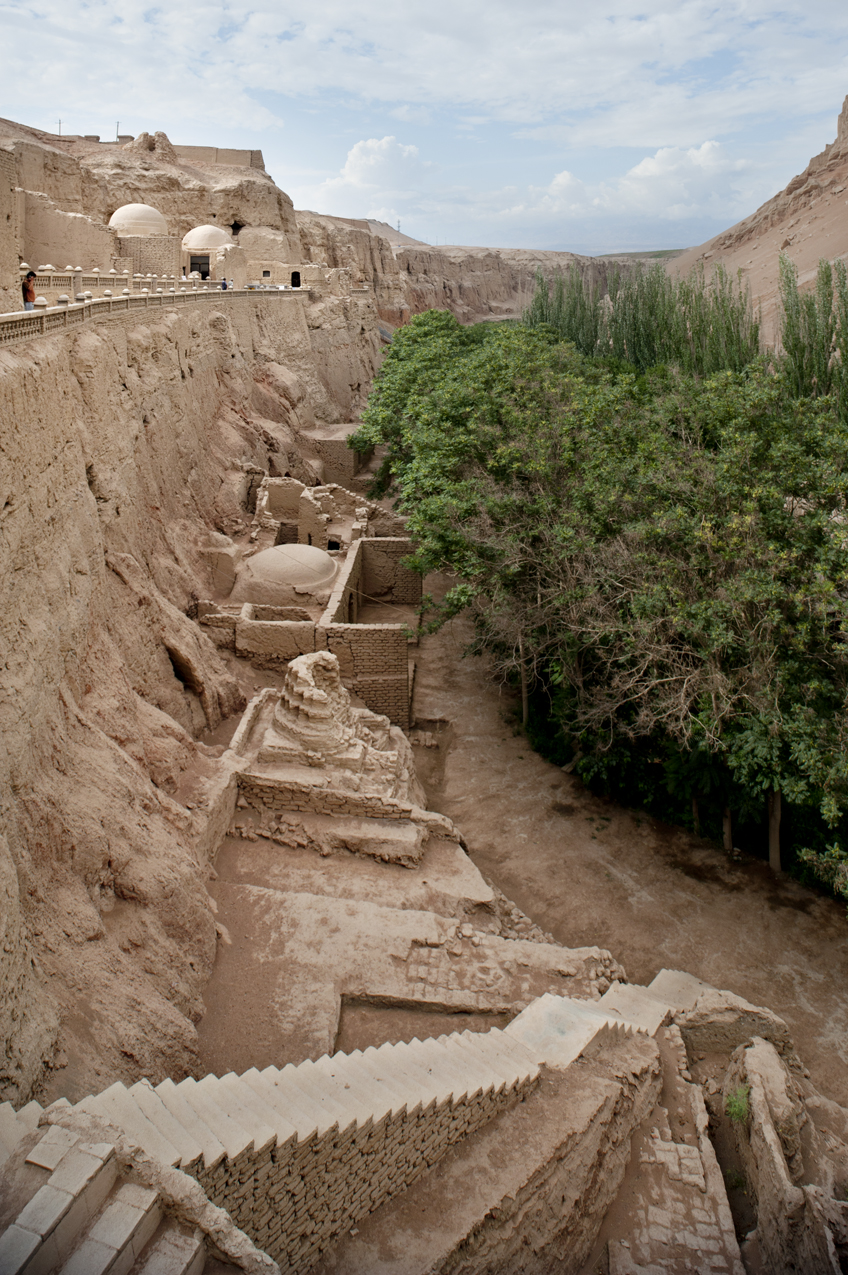
These are the Bezeklik caves, which my cab driver convinced me to see. Although picturesque, they were a big disappointment on the inside, especially since i had recently seen the Mogao Caves. Almost all of the frescoes had been cut out of the walls by a German Archaeologist. He brought them to Berlin, and most of them were destroyed during World War II. It was pretty depressing.

Night Train to Turpan

I’ll be taking a sleeper train to my next destination, Turpan, today, so I won’t be able to post anything. I’ll be kind of sad to leave Dunhuang because I’ve grown attached to this place.
Turpan will be my first destination in the Xinjiang province, which was once called “Chinese Turkestan.” It used to be the case that all the people who lived there were of a different ethnic group, Uighur (pronounced WEE-gur), but the Chinese have been migrating there over the past ten years. Now, it’s about 50-50. At any rate, it is decidedly Central Asian, and I’m trying to learn the basics of the Uighur language so that I can communicate a little bit with the locals. It’s much easier to learn than Mandarin. I’ll let you know how it works out.

Beating the Heat

It was a hot one here today.  I spent the day exploring the amazing Mogao Caves, a Unesco World Heritage Site.  These were temples carved out of a cliff in the middle of the desert, and they contained incredible frescoes with early experiments in perspective that predated anything Giotto did by centuries.  They were painted in the most expensive colors at the time:  blue, turquoise, red, and orange.  The colors ended up looking like those from the first experiments in Technicolor.  All of these frescoes have been well preserved by the dry air.  The Indian influence was very apparent in the patterns and designs in some of the earlier caves, which were first built in 366 AD.  Understanding this sort of ornamentation was one of the reasons that I came on this trip.  Unfortunately, there was absolutely no photography allowed within the caves, and sketching was impossible because I could only see them on a guided tour.  It was well worth the trip and the hassle, though, and will hopefully be something that I remember for a long time to come.

One of the caves was originally used as a library, and its entrance was completely concealed by sand for about five hundred years.  When a monk stumbled upon it at the beginning of the twentieth century, word soon got out to the European and American archeologists who were going around pilfering all of Asia’s cultural treasures.  They stole some twenty thousand ancient manuscripts, including the oldest known printed piece of paper, and brought them back to museums in their home countries.  Most of them are now housed at the British Museum.  An american from Harvard ripped many of the frescoes off of the walls, and they are now housed at the Fogg Museum.  Nevertheless, what was there was incredibly impressive.  The caves were also about 25 degrees cooler than the outside air.  For more on the manuscripts, check out:  http://idp.bl.uk/.  Also, check out some of the images of the interiors on Google.

Here are the limited photos that I have for the day:

The entrance to one of the more impressive caves, containing a 35-meter tall Buddha that was carved out of the rock. He was seated this time, and was wearing brilliant red robes. There was also a beautiful reclining Buddha in another cave, along with the frescoes that I mentioned above.

The cook prepares my lunch, hand-pulled noodles.

The actual dish

The delicious noodles, piping hot. For some reason, the Chinese think it's a good idea to eat ridiculously hot food on a hot day. I don't get it.


Make Way for Tomorrow, Dunhuang!

Today was a big rest day, but I spent a good portion of the it exploring the town, and then met up with the friends that I met in Jiayuguan for dinner.  Like so many other cities in China, Dunhuang is a city in transition, modernizing faster than the locals can keep up.

Here are the photos (remember to click to enlarge):

Tradition meets progress head-on.

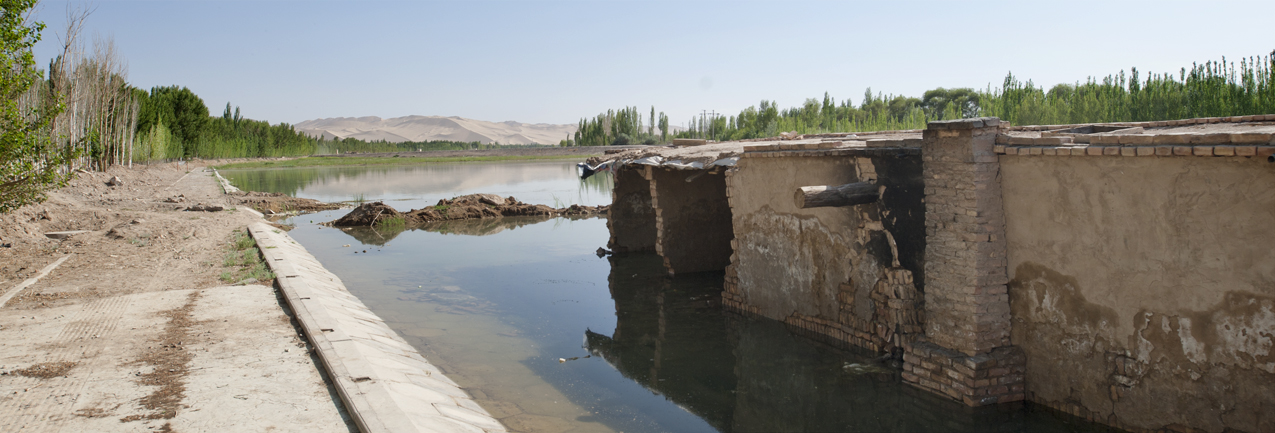
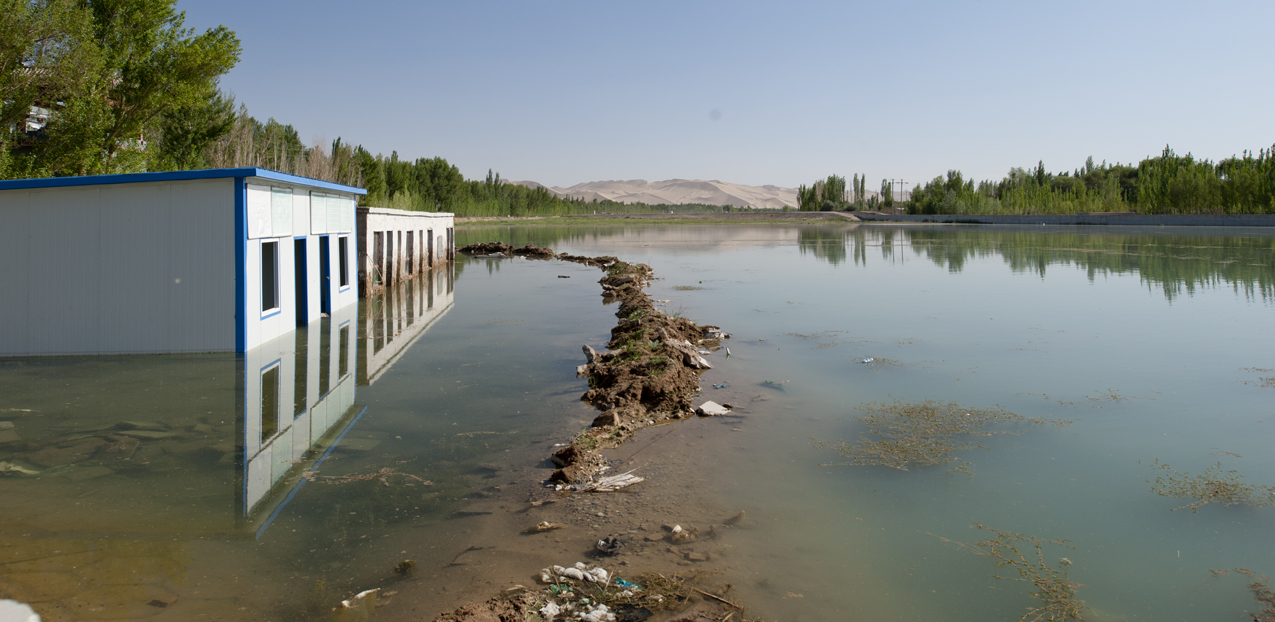
The city is developing a new riverfront, however, there was never such a big river here before. There is a spring, which has been used to create these stagnant pools that may look like a river (we are in the middle of an immense desert - there are no rivers here). At any rate, it seems like conspicuous consumption, given the massive sand dunes of the desert in the background.

Homes and shops once occupied the area that is to become the riverfront.

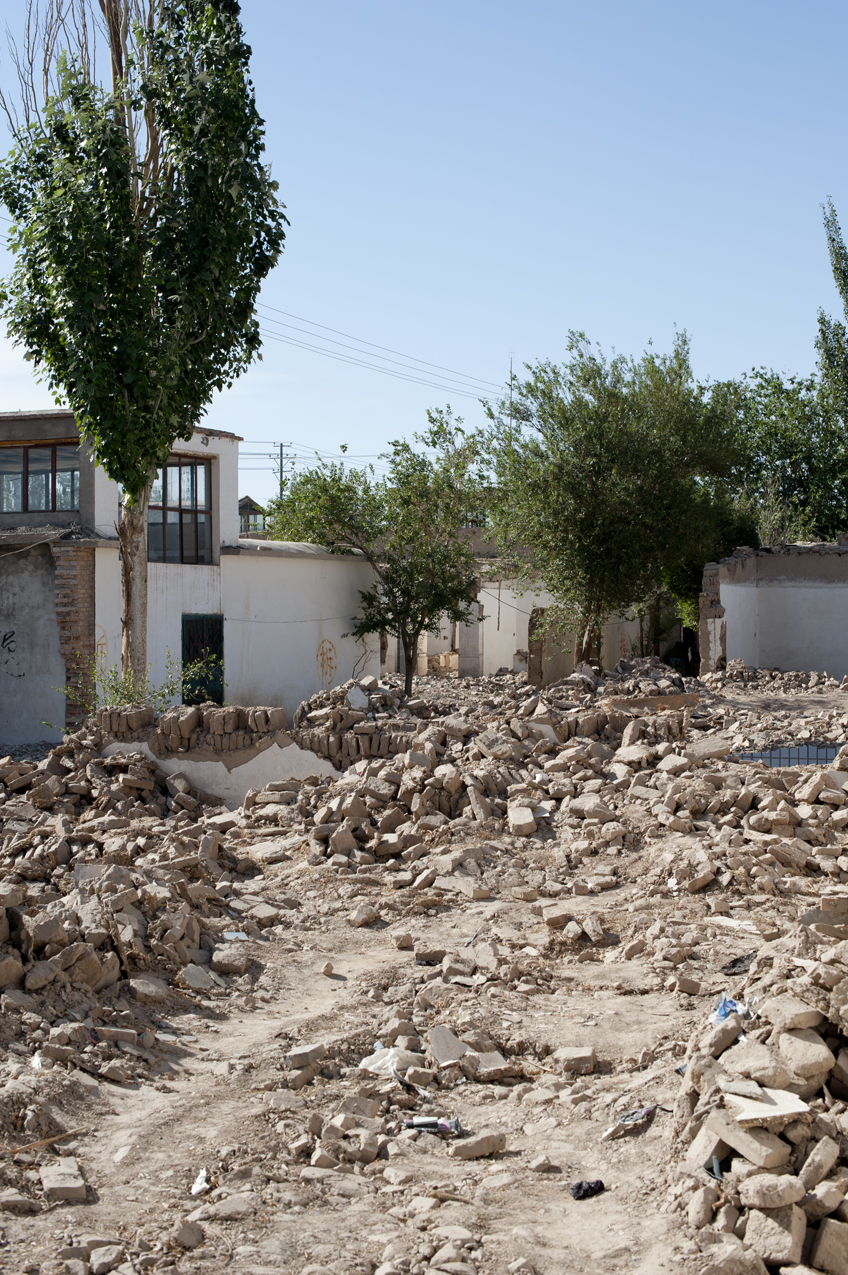
A neighborhood is completely erased to make way for the next thing - mid-rise condos.

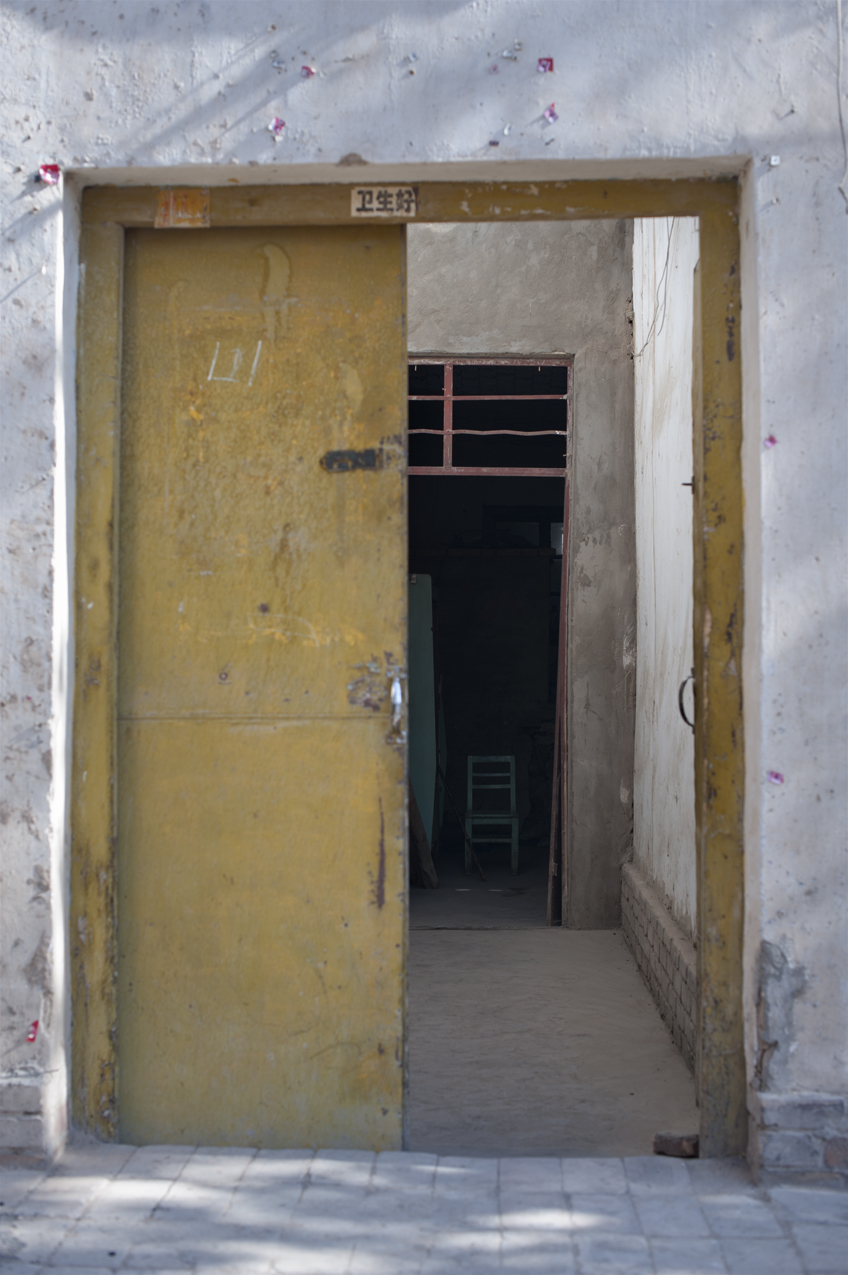
People still live in some of the homes in a neighborhood slated for inevitable destruction. Soon. this will be prime condo-land with river views.

These houses were built over centuries, with gradual additions, and are being torn down to make way for the new neighborhoods that will face the new riverfront.

Make way for tomorrow! It's coming fast.

The remnants of a teaching facility, slated for demolition soon.

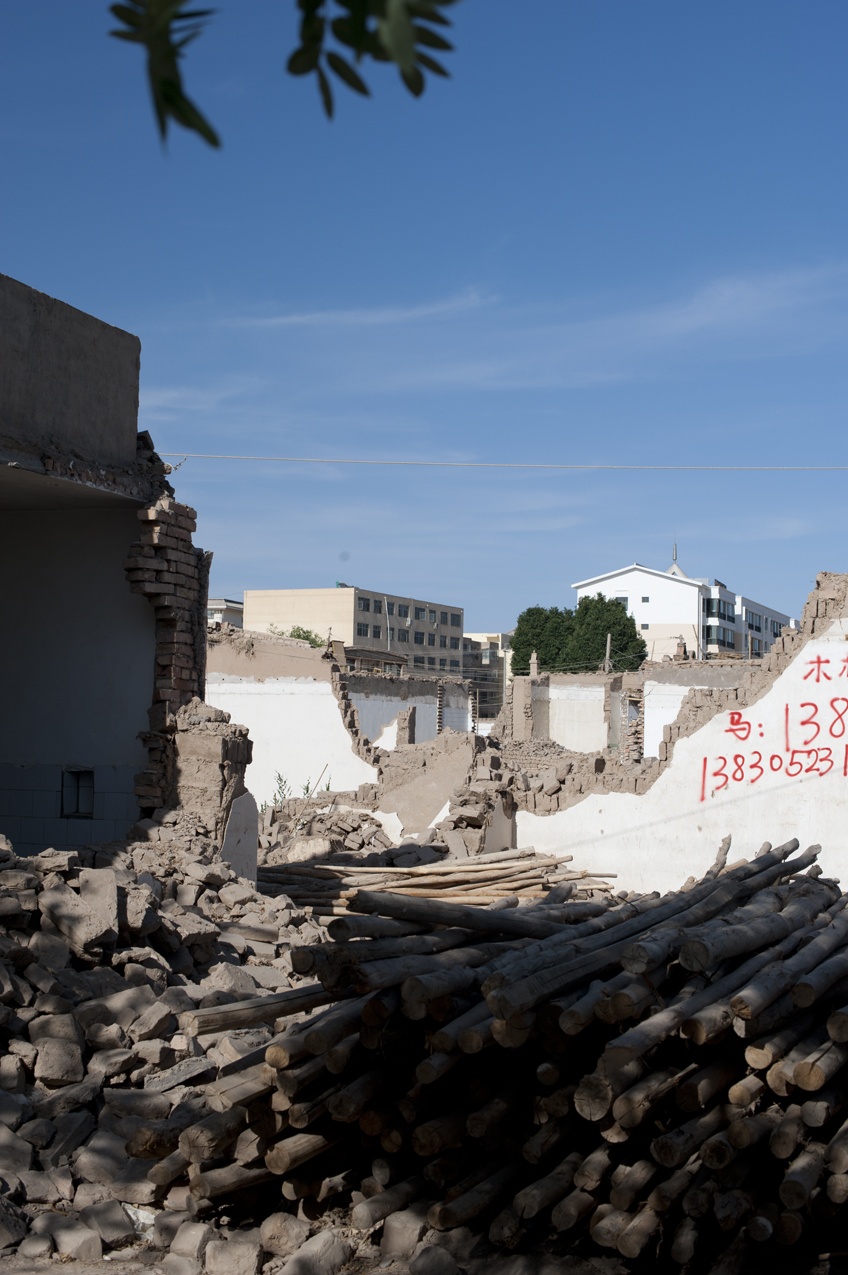
Everything that can be salvaged from these houses is, or has been.

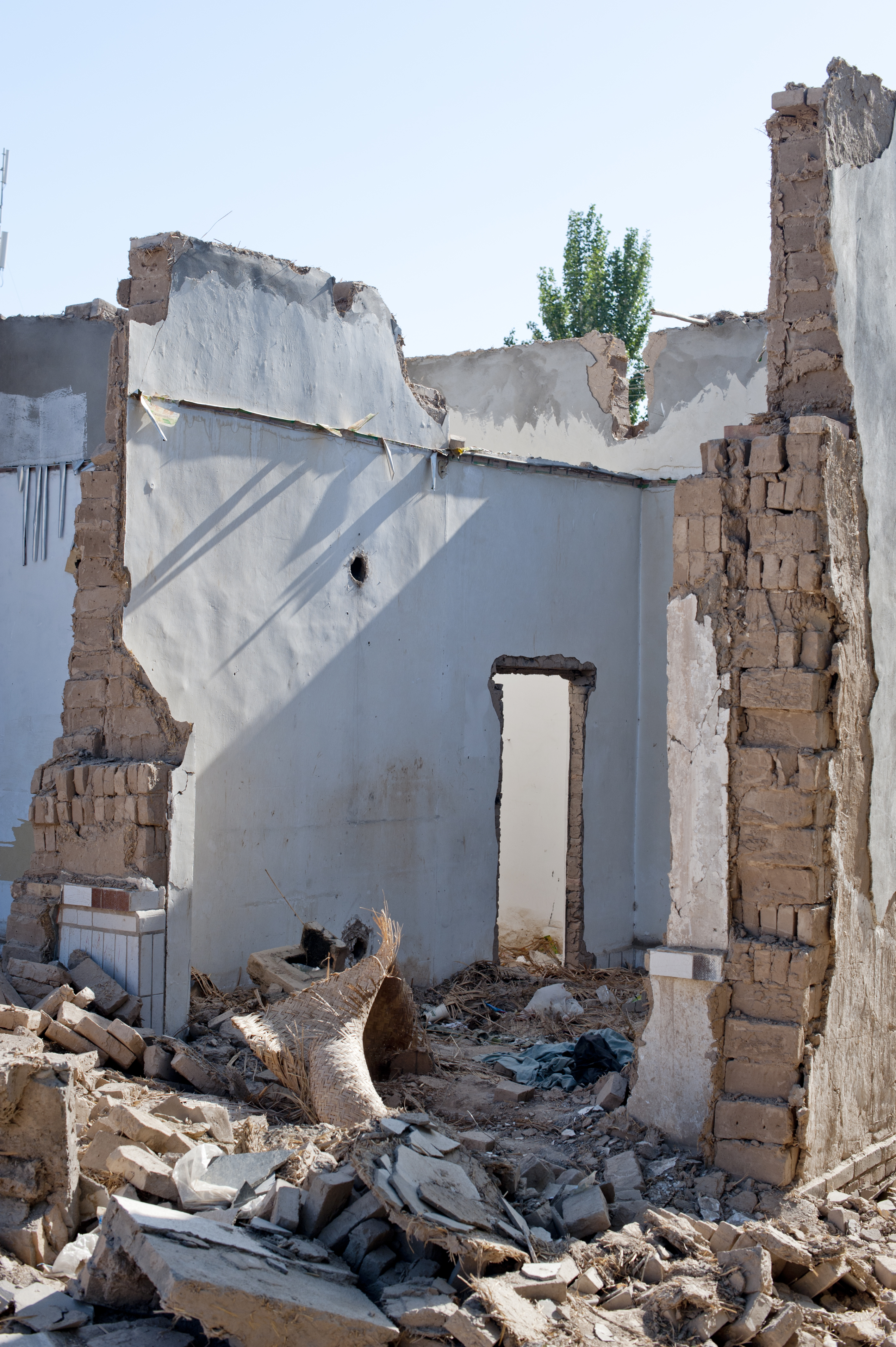
The destruction is relentless.

Like so many war-torn battle regions, Dunhuang prepares for the future by creating a blank slate.

Encroachment from the 1950s.

Make way for tomorrow: it's happening sooner than most could have ever guessed.

Construction and rendering collide.

The first good bread that I've encountered in quite a while.

Dinner: Lamb and vegetables.

A dish that I'd rather forget.

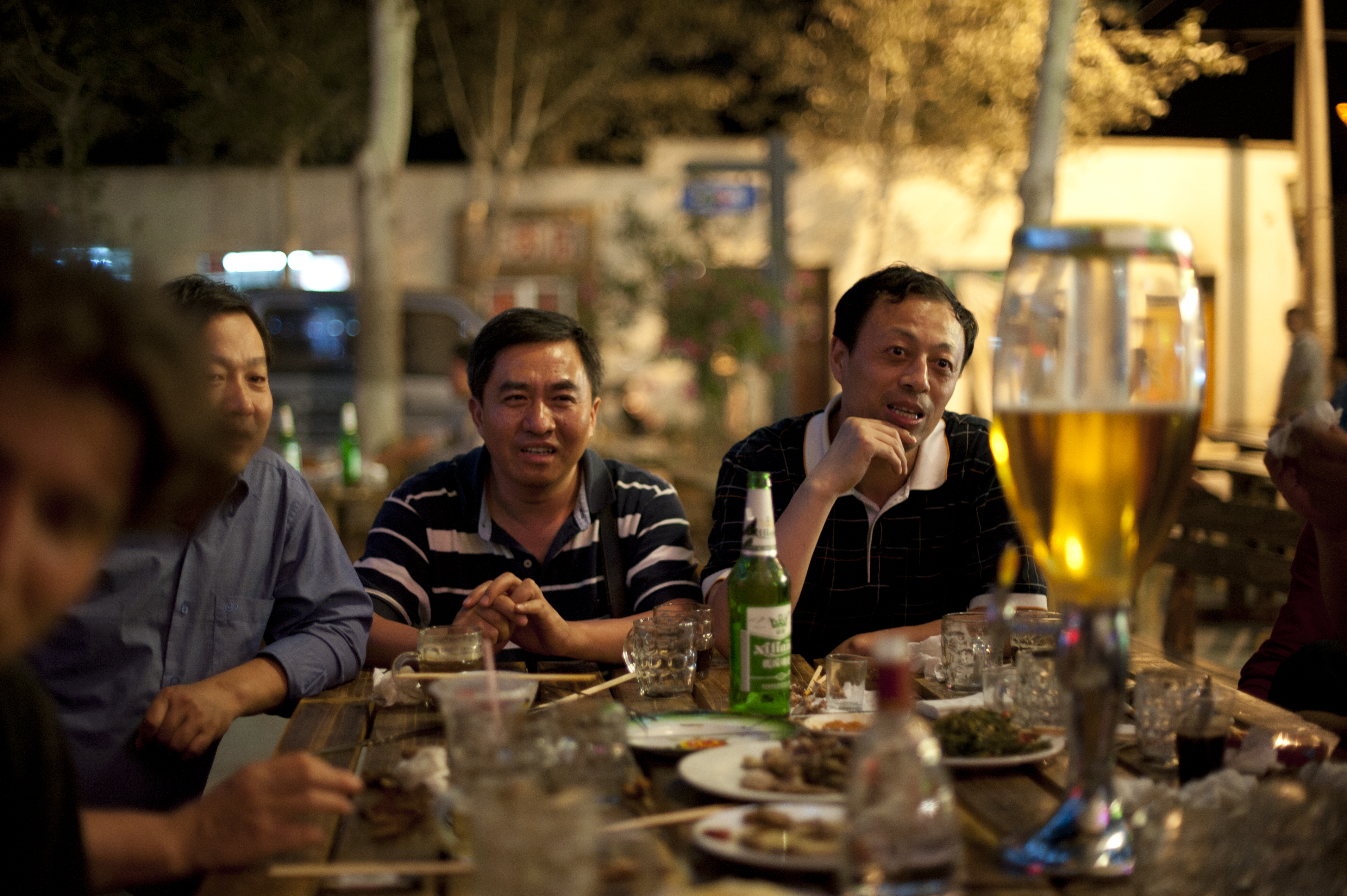
A mighty feast, courtesy of some local gentlemen.

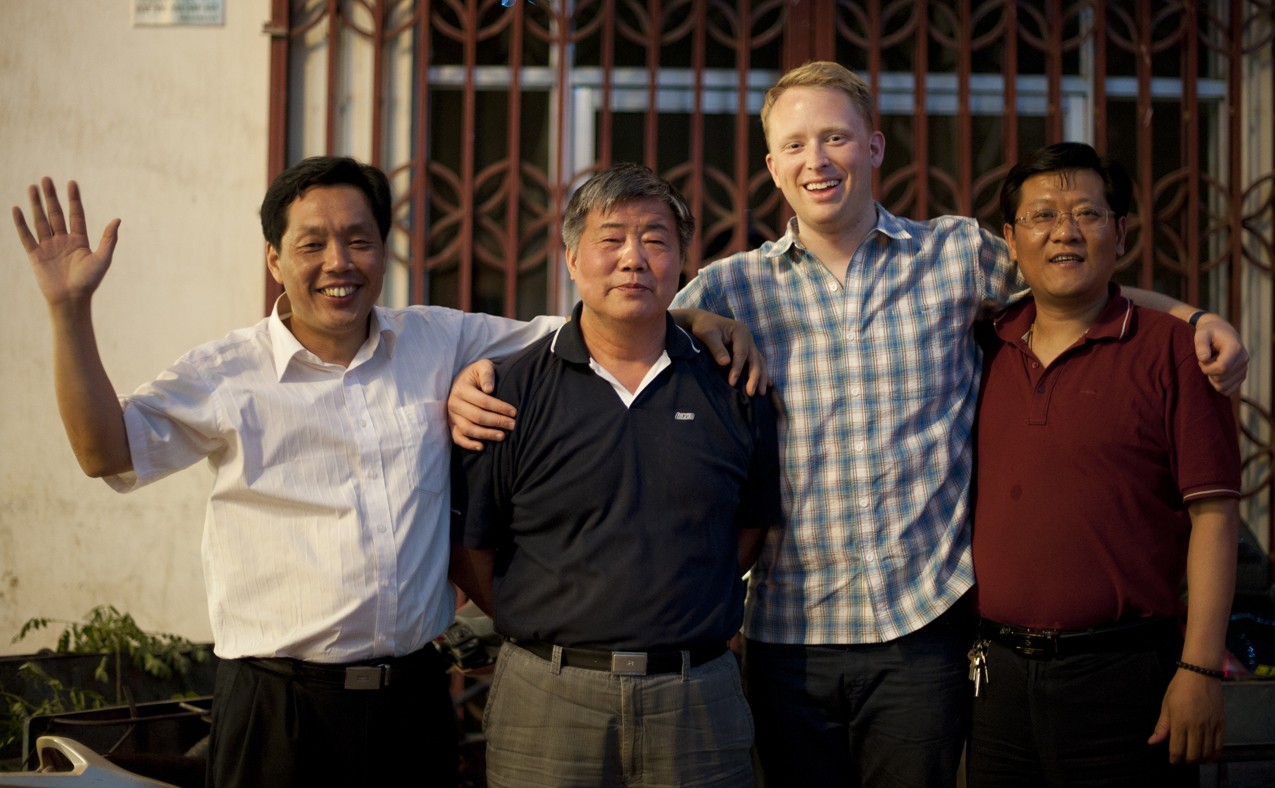
Our new friends - anxious to meet us, and even more anxious to share.

These men will have no recollection of meeting me in the morning.

Natalie tries to shrug off her new found buddies.

Mickey, the ultimate translator, and cultural ambassador.

Deserts and Defenses

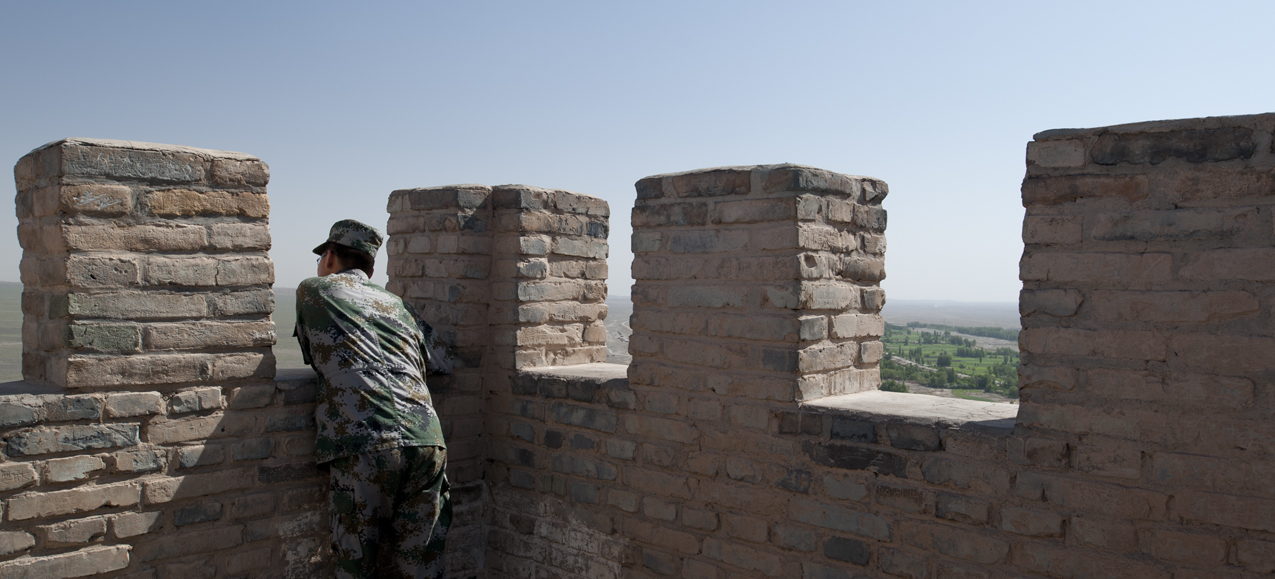
After an early breakfast this morning in Jiayuguan, I set out for the Great Wall and the town’s ancient fort, which traditionally marked the western edge of China.  It’s not possible to reach these sites by public transportation, so I had to hire a cab for a half day.  Fortunately, I got an early enough start that I was the first tourist at the wall today, and I didn’t have to deal with any crowds at all.  The climb to the top of the hill was pretty tough in the morning heat already, though.  As I was up there shooting a couple of photos, the soldier seen in the picture above wheezed his way up to the guard tower.   From the wall, I went to the Jiayuguan Fort, which sits in a strategic position at the mouth of the Hexi Corridor, the valley through which I’ve been traveling for the past few days.  It was impressive, but a bit touristy.  Both of these sites were restored about 25 years ago, and I wonder how they looked before.

I spent the entire afternoon on a bus, and arrived in Dunhuang in time for dinner.  This seems like a great town, and I’m really looking forward to spending the next few days in the area.

Here are the pictures:

It might not look like it, but it's a tough climb to the top.

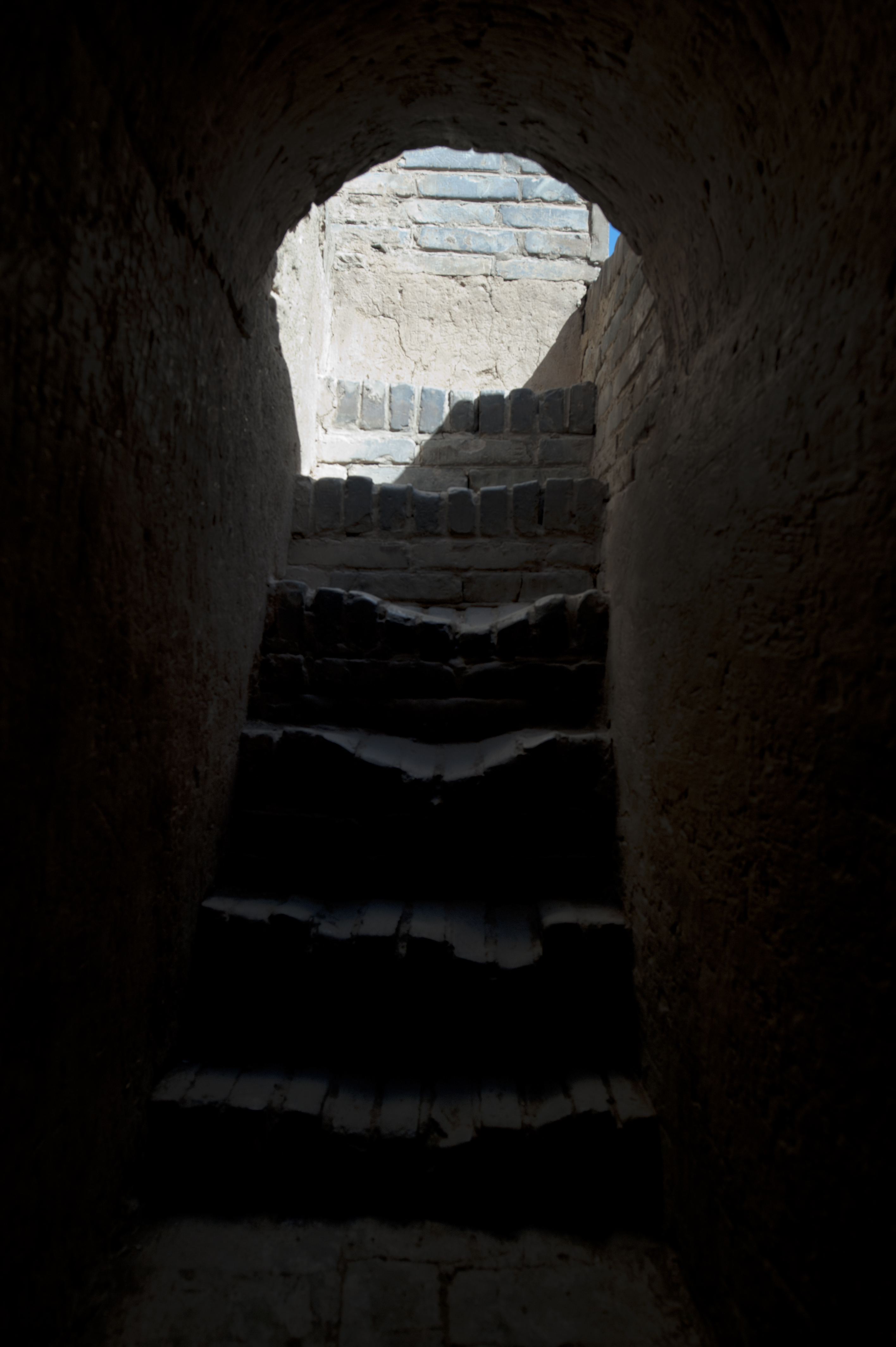
The well-worn steps in the guard tower

The wall in this part of China was built from mud and rammed earth, so it doesn't quite look like the wall in the photos that most of us have seen. If you look really closely, you can see a man polishing a sign post to the left of the tower.

Maybe this is a dumb question: Isn't the ridge enough of a natural barrier already?

I hadn't realized that caravans still traveled in these parts. The merchants seem pretty friendly, too.

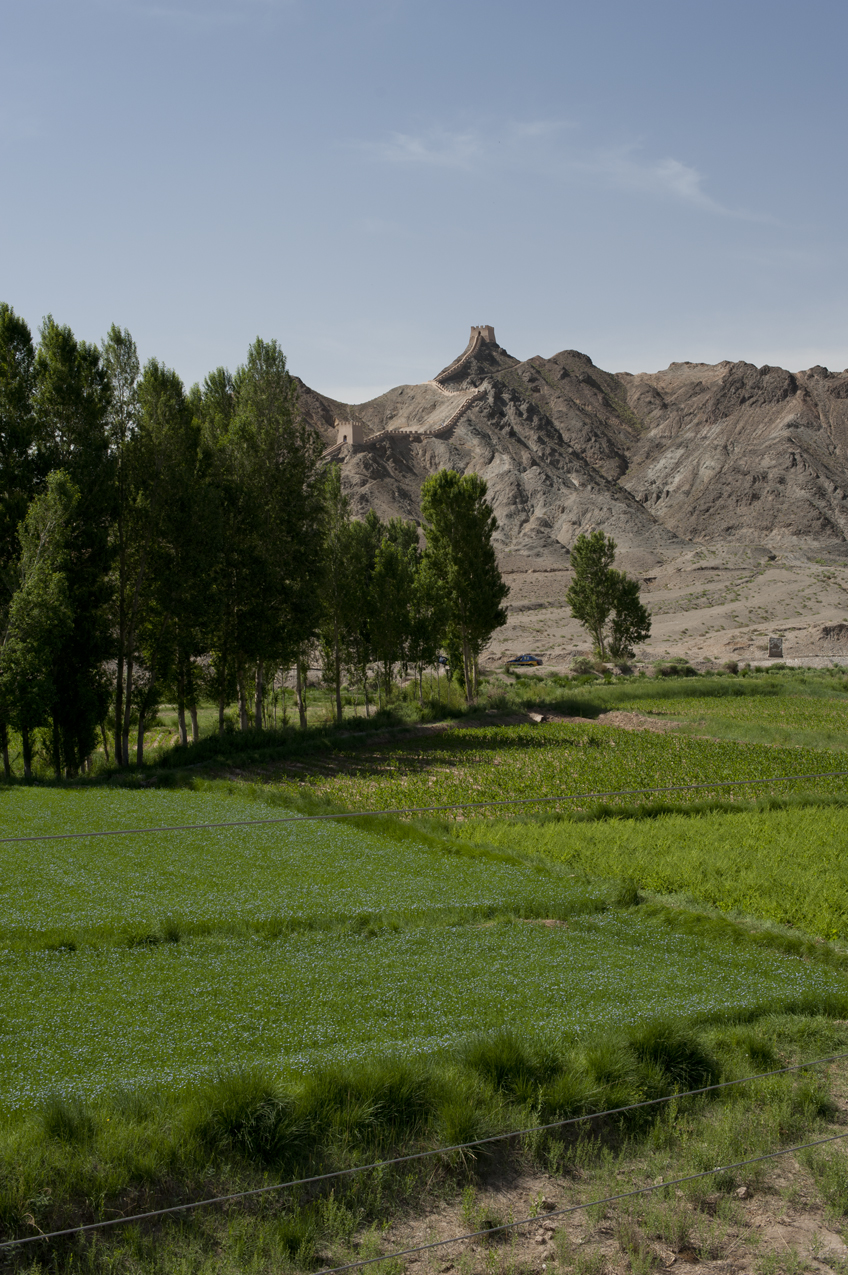
Farmland and desert meet pretty abruptly in this region. You can see the wall in the background.

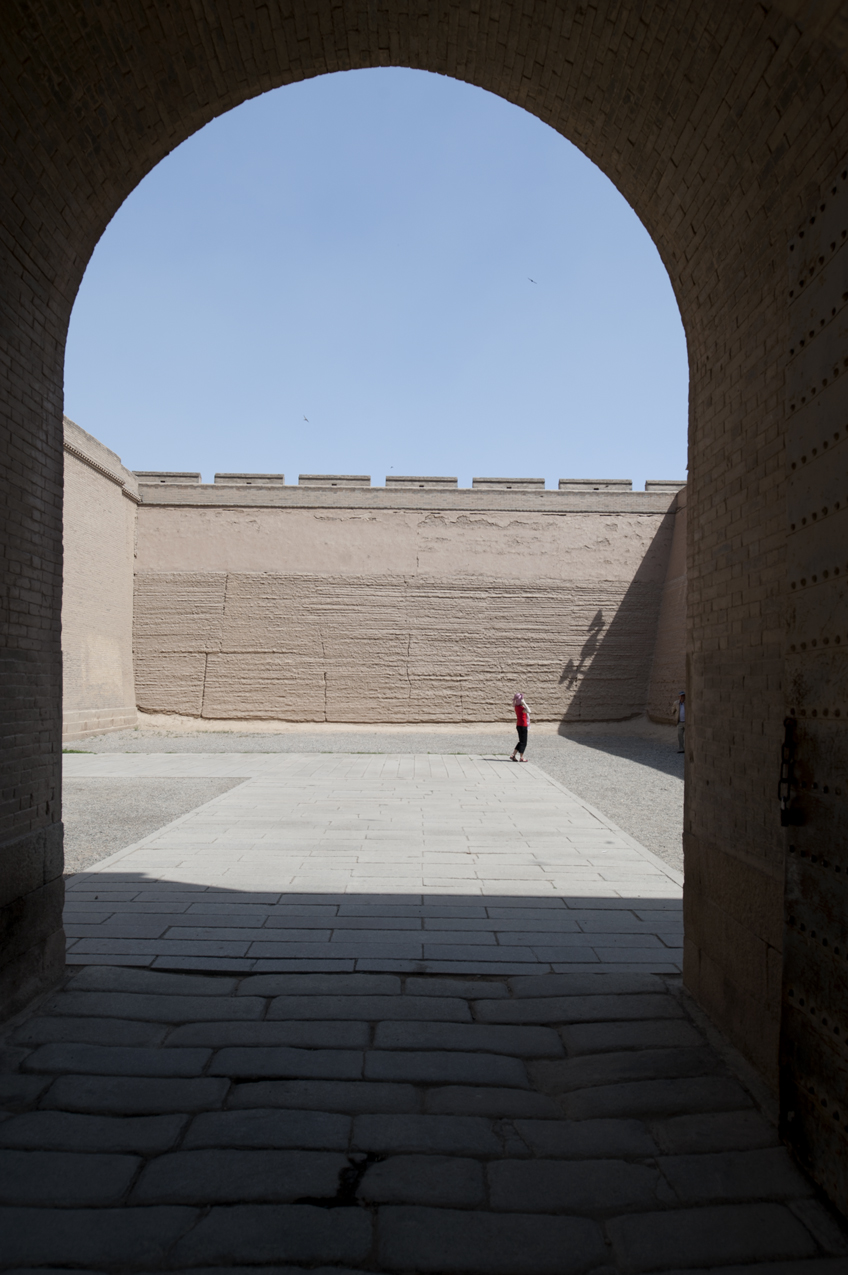
The forecourt to the Jiayuguan Fort. All goods traveling in and out of China along the Silk Road passed through this point.

The general's quarters were in the buildings in the foreground (not much of a view form there, though).

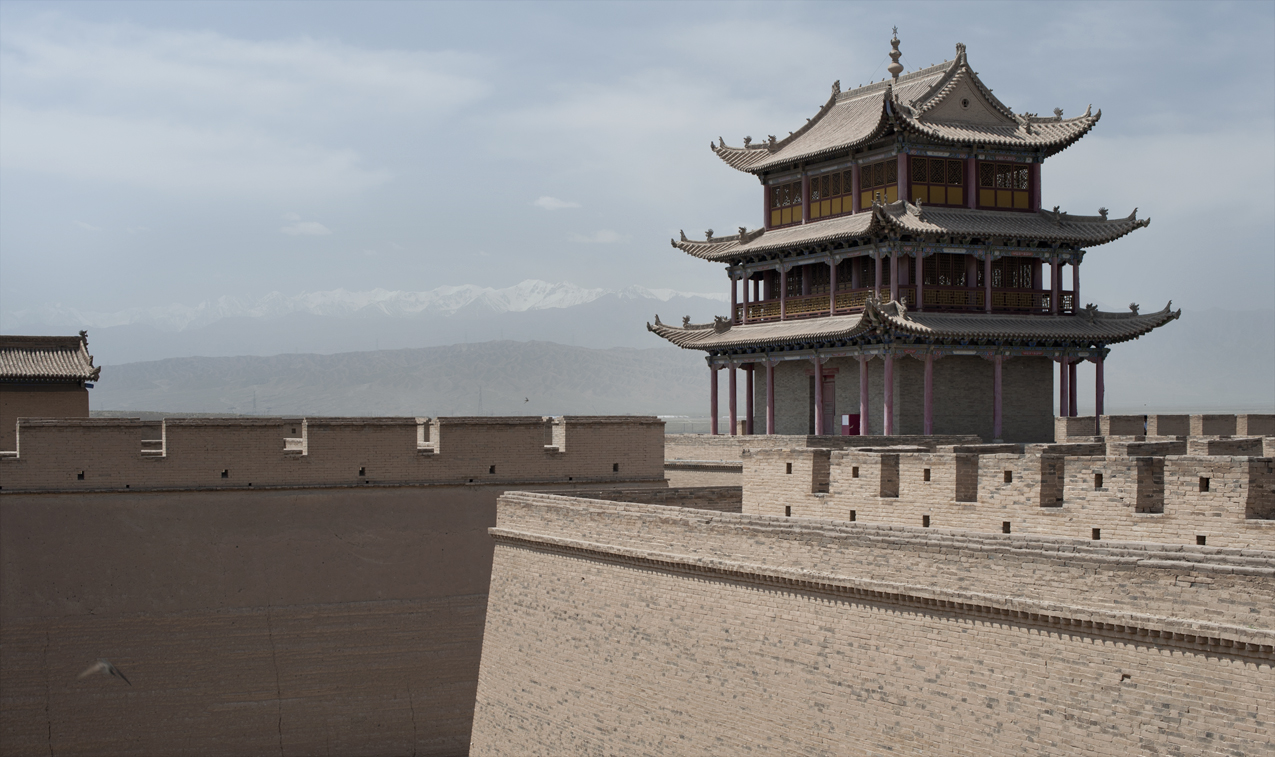
From the Chinese perspective, the civilized world ended at this fort.

I rode the bus through the Gobi Desert today, on my way to the next destination, Dunhuang. At one point, these mountains suddenly became sand dunes. I'll visit these over the next couple of days, so you'll see plenty of pictures of them soon.

the other side of the bus faced nothing but open desert for long stretches, only interrupted by huge wind farms and their associated electrical towers.

you can see my fresh hand pulled noodles being prepared by the guy on the right.

My dinner: hand-pulled noodles with a variety of vegetables, and chicken. The noodles were incredible, and cooked to perfection. This was much more similar to an Italian meal than anything I thought I'd get out here.

Dunhuang has a really mediterranean atmosphere with a network of pedestrian streets that are set up for al fresco dining.

The religious history of the region pokes out in different places. This area was once an important Buddhist pilgrimage site, then Islam swept through, and then the Communists. Each left very different architectural marks.

The first minarets I've seen so far.

Fellow Travelers

Today, I said goodbye to Zhangye, and traveled by train to Jiayuguan.  Before I left, however, I took a walk around the city, and found whole different worlds on the interior of the large blocks.  Buried behind the modern buildings facing the street, were traditional neighborhoods that had been around for centuries, and were still occupied in the same way.  I also came across a sculpture commemorating Marco Polo’s visit to Zhangye.  I’m basically following his route in reverse, but this was the first time that he and I met eye to eye.  The cheese factor was incredibly high.  Also, it’s been argued recently that he never even made it to China, but just wrote his diary based on other the stories he had heard from other travelers, so I guess I have one up on him there.

I nodded off on the train ride, so I don’t have much new to report there, but I arrived safely in Jiayuguan, which is another oasis town.  It’s got little history remaining, and is now pretty much a communist era city, which was fascinating to see for a change.  Here, while searching for dinner, I ran into a couple of Americans who have been teaching in China for the past year.  We ended up having a feast together.

Here are the photos.  Remember that you can blow them up if you click on them.

My traveling predecessor, Marco Polo, as commemorated in Zhangye

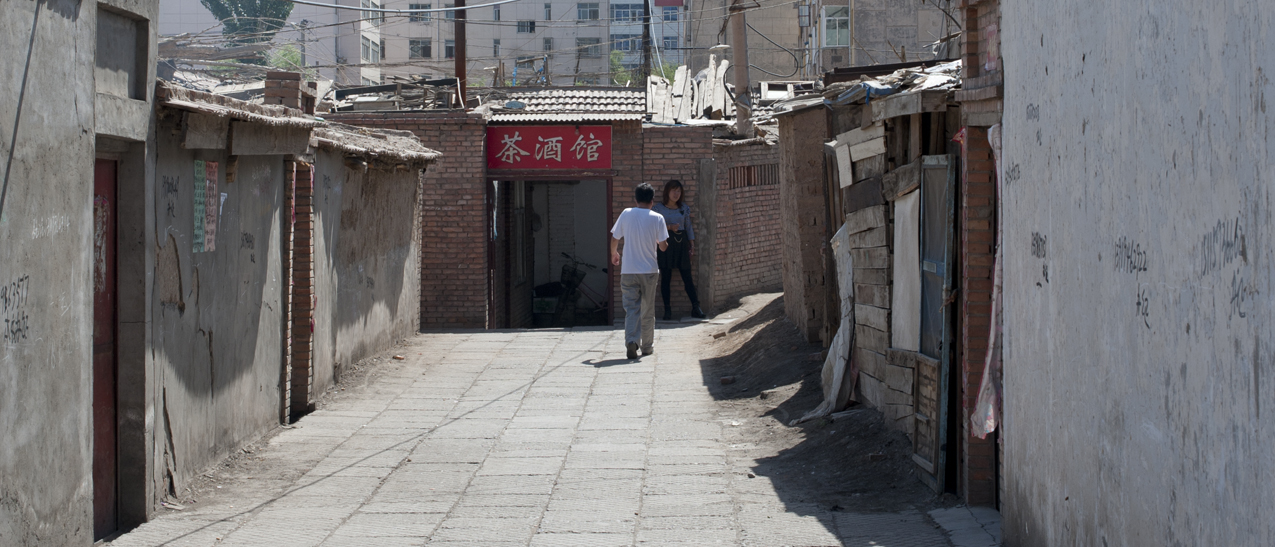
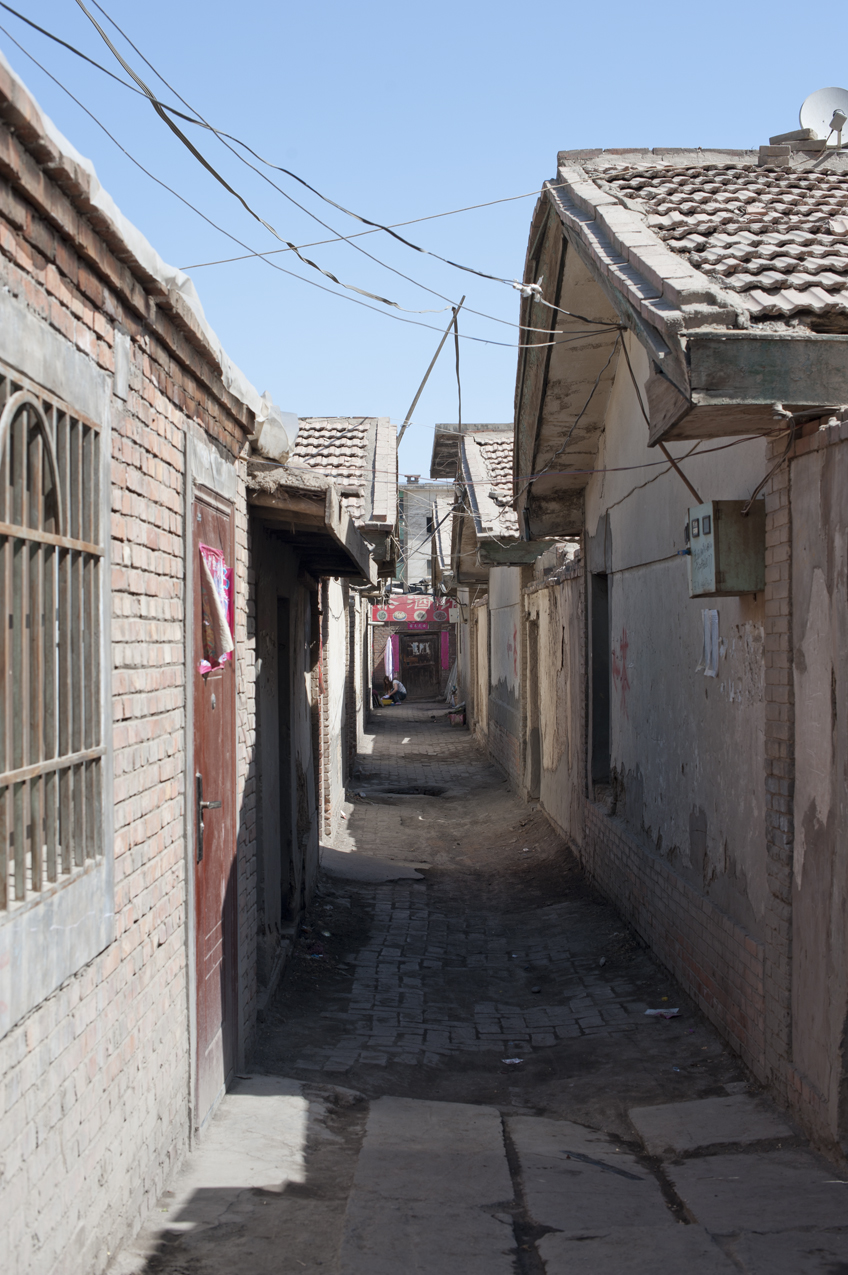
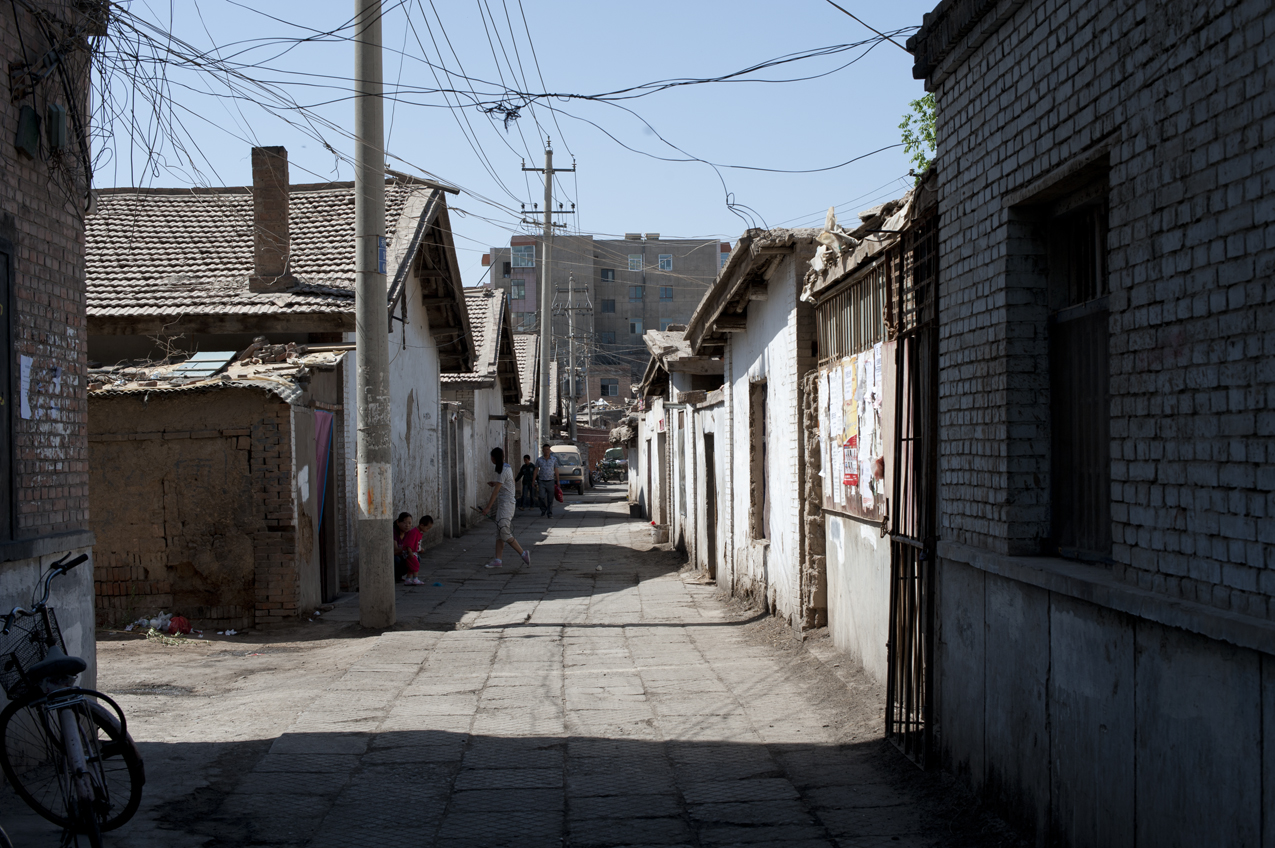
Zhangye is a city of contrasts. These narrow alleys are lined with traditional mud brick and rammed earth homes. They've been occupied by the same families for centuries.

Modernism is slowly taking over. Now, these traditional neighborhoods only occupy the center of blocks. Modern high-rises occupy the main streetfronts. You have to search for these old neighborhoods to find them now.

To be honest, though, it's not all rosy in these areas. The stench is overpowering. There is no plumbing, and bathrooms are communal.
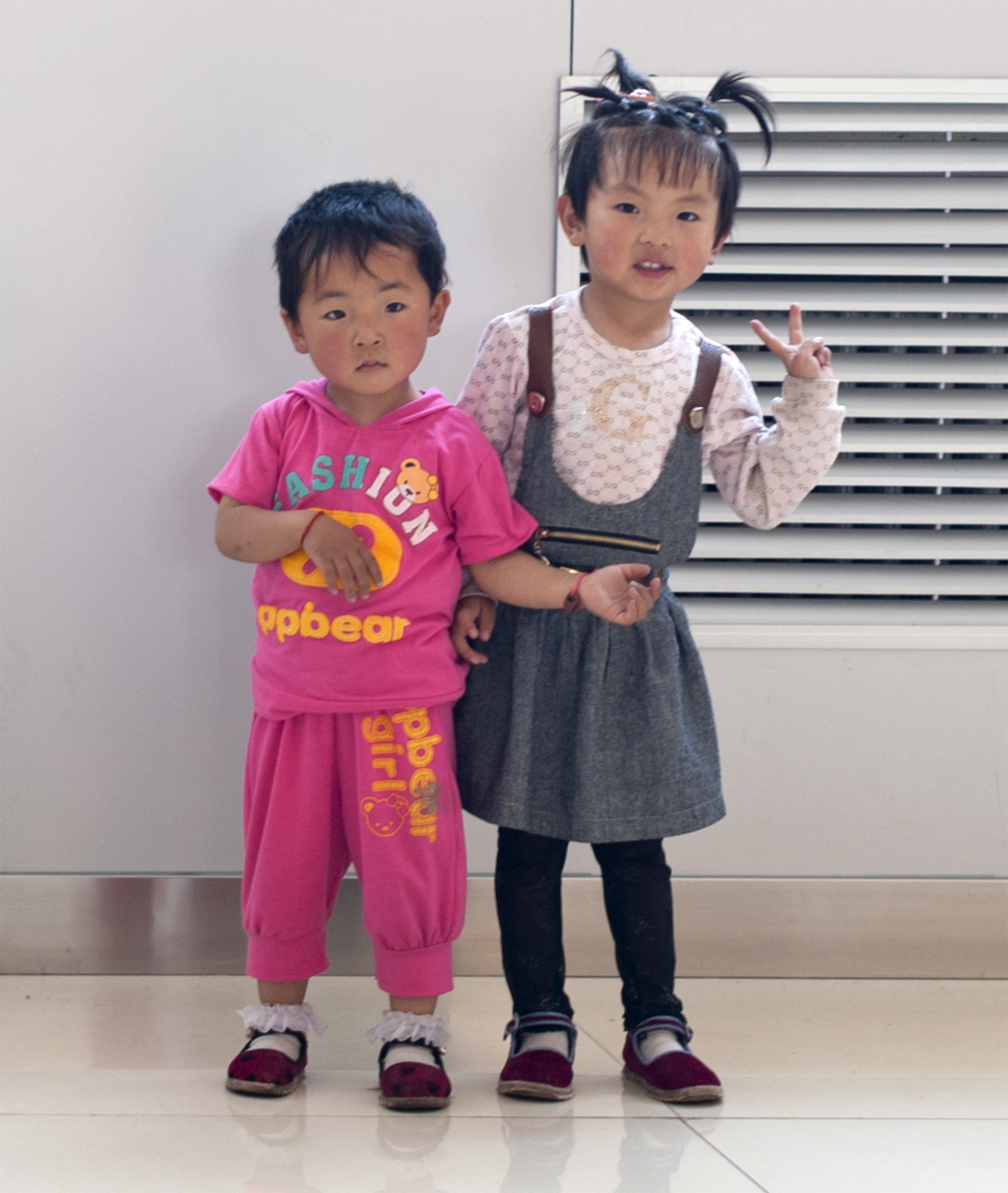
This is another little friend that I made in the train station.

Here she is with her even smaller cousin.

My snacks for the train ride: Uighur peanuts.

My hotel left these snacks out for me in my room. Not a bad welcome.

Jiayuguan is a frontier town with some historical sites on the outskirts. This is part of the legacy of the last fifty years.

Mao had these housing blocks built - quite a contrast from the inner neighborhoods of Zhangye.

Who says communist housing can't be quaint?

This sis the beer that I mentioned in my last post. It hasn't gotten any better.

A freshly barbecued meal in Jiayuguan.

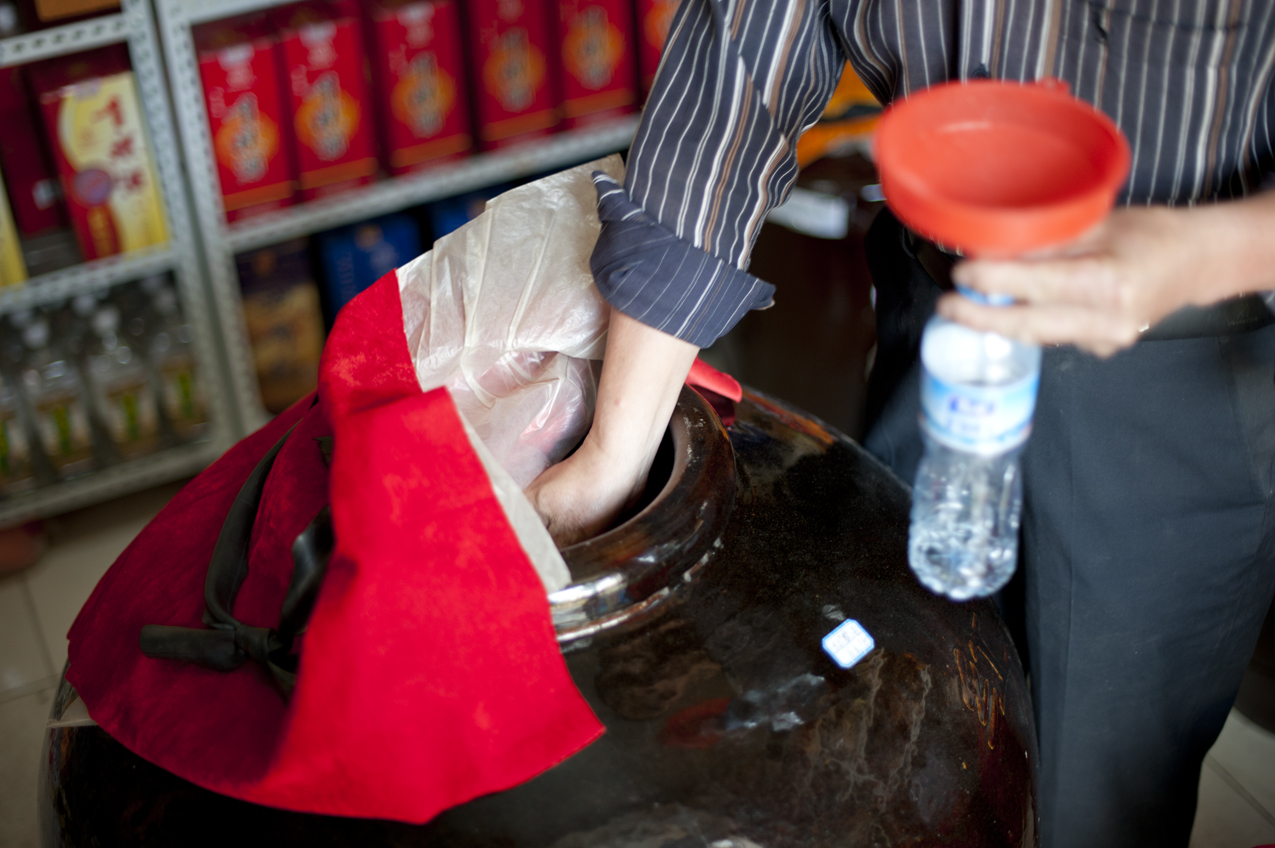
The infamous rice liquor from this region is sold by the cup-full out of these enormous casks.

Pretty fresh seafood at this stand. They will cook it up for you in a matter of minutes.

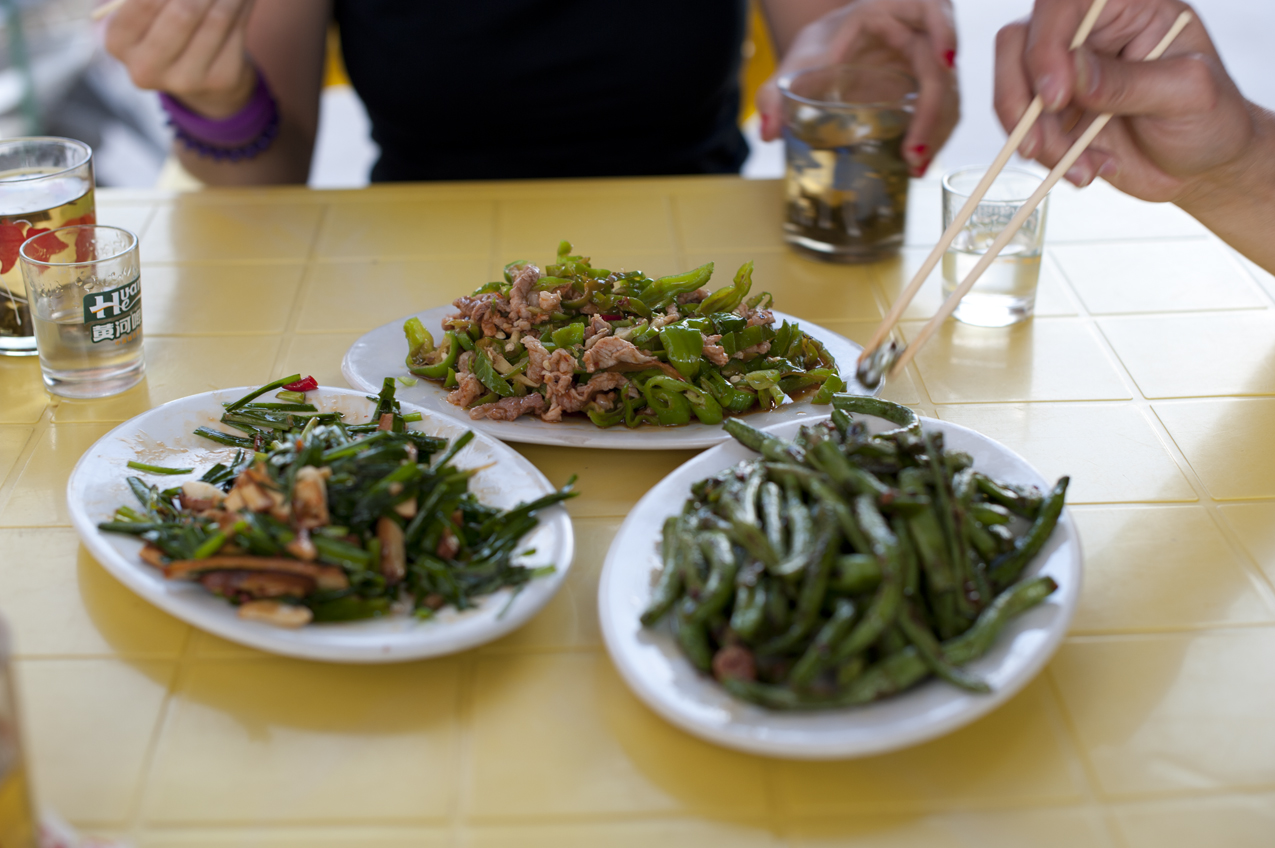
A feast with some new friends from the states, both of whom spoke Mandarin. This time, I actually knew what I was eating: tofu with scallions, spicy green beans, and chicken with hot peppers. It was delicious, and it was nice to swap some stories with fellow travelers.

A Few Quick Observatons

Here are just a few things that I’ve noticed since arriving in China:

  • I only get one english TV station, CCTV News (China Central Television), and it is astounding to me how the news gets filtered through it.  For instance, the southeast of China is experiencing some disastrous flooding right now, and the lead in for the story was, “The long drought in the Southeast is finally over.  Farmers are no longer struggling with dry conditions.”
  • If you like warm, flat beer that tastes like dishwater, then China is the place for you.
  • It is perfectly acceptable, in fact seemingly encouraged, to clear phlegm audibly, and then expectorate in public.
  • Traffic lanes are just kind of a suggestion.  Also, many major intersections do not have any lights at all.  People just drive through honking their horns.
  • Although crosswalks are painted on the pavement, they can generally just be viewed as street art since they serve no purpose.

Today is a travel day.  I’m heading to Jiayuguan, and will spend one night there before heading to Dunhuang.

Fresh Air and Tight Spaces

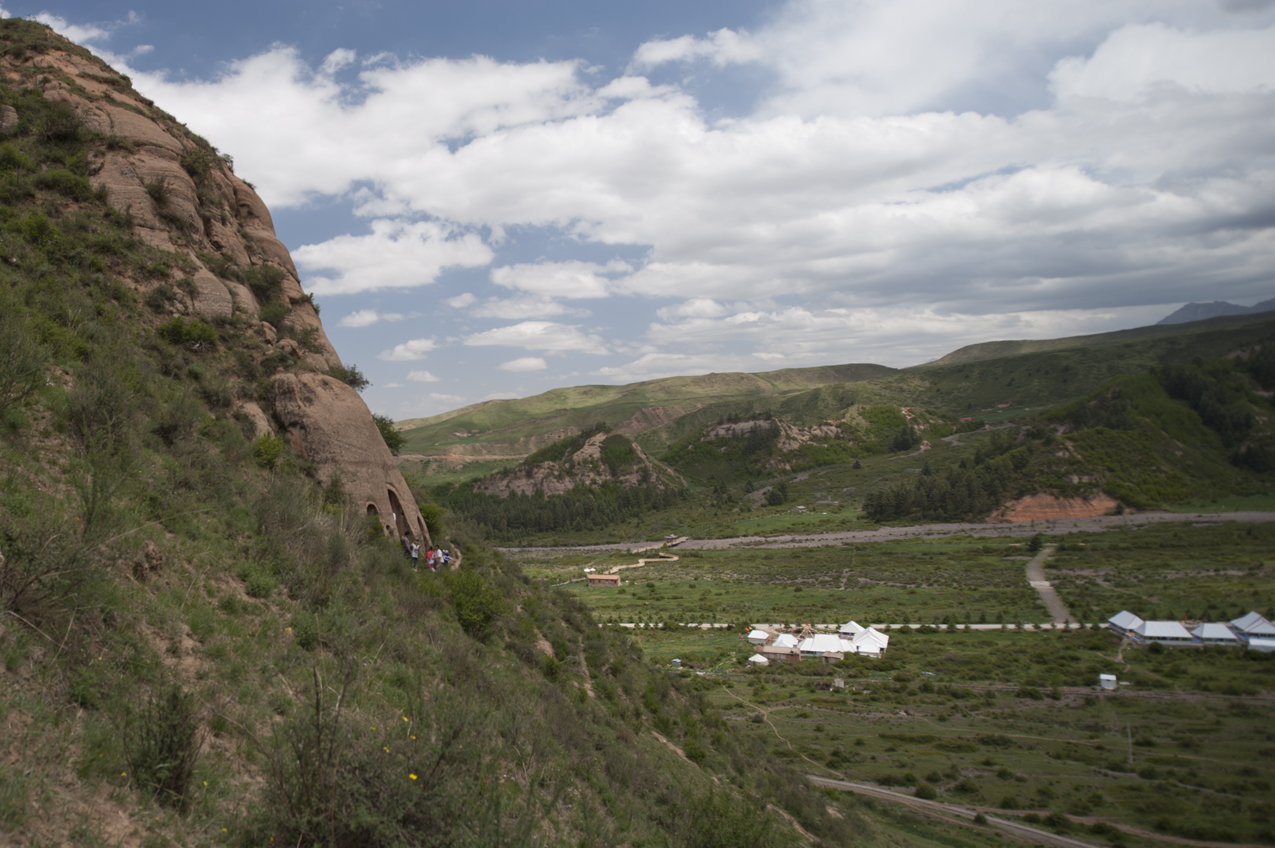
Hello again from Zhangye.  I had an incredible day today visiting Mati Si, a site up in the foothills of the mountains where there is a large temple built into the side of a cliff, and hiking around the mountains nearby.  The hour and a half bus ride to the small village at the base of the site was almost worth the price of admission.  I passed from the fertile oasis and farmland of Zhangye through desert, with ruins of ancient forts, and up into breathtaking mountains.  Of course, the bus was moving too fast on ridiculously bumpy roads for me to take any photos.

If I had a choice between seeing Mati Si, or seeing the Terracotta Warriors, I would pick Mati Si in a heartbeat.  Although there is a little tourist village with annoying hawkers in the valley below, and the price of admission and transportation make the excursion a little steep, it was well worth it.  Other than a family who kept following me around to get some snapshots of me for their vacation album, and a really persistent Tibetan woman who insisted that I ride her horse, I didn’t see anyone on the trails at all (there were probably a dozen people in the temple).

It’s been an exhausting day, so I’ll let the pictures do the talking.  By the way, for those loyal readers who did not know this already, you can click on any of the photos to make them larger (this may come in handy with yesterday’s Great/Wimpy Wall photo).

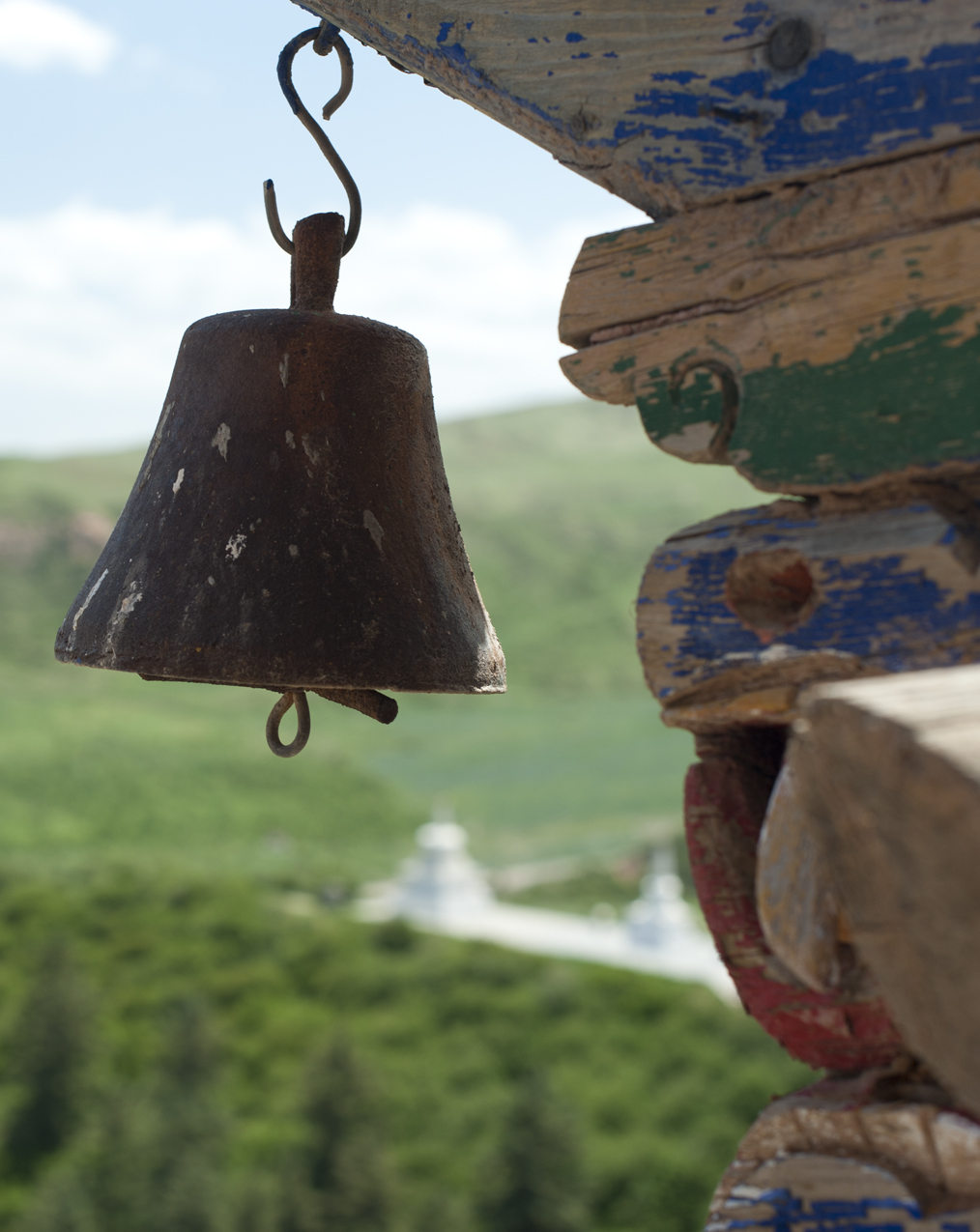
A stupa with a view

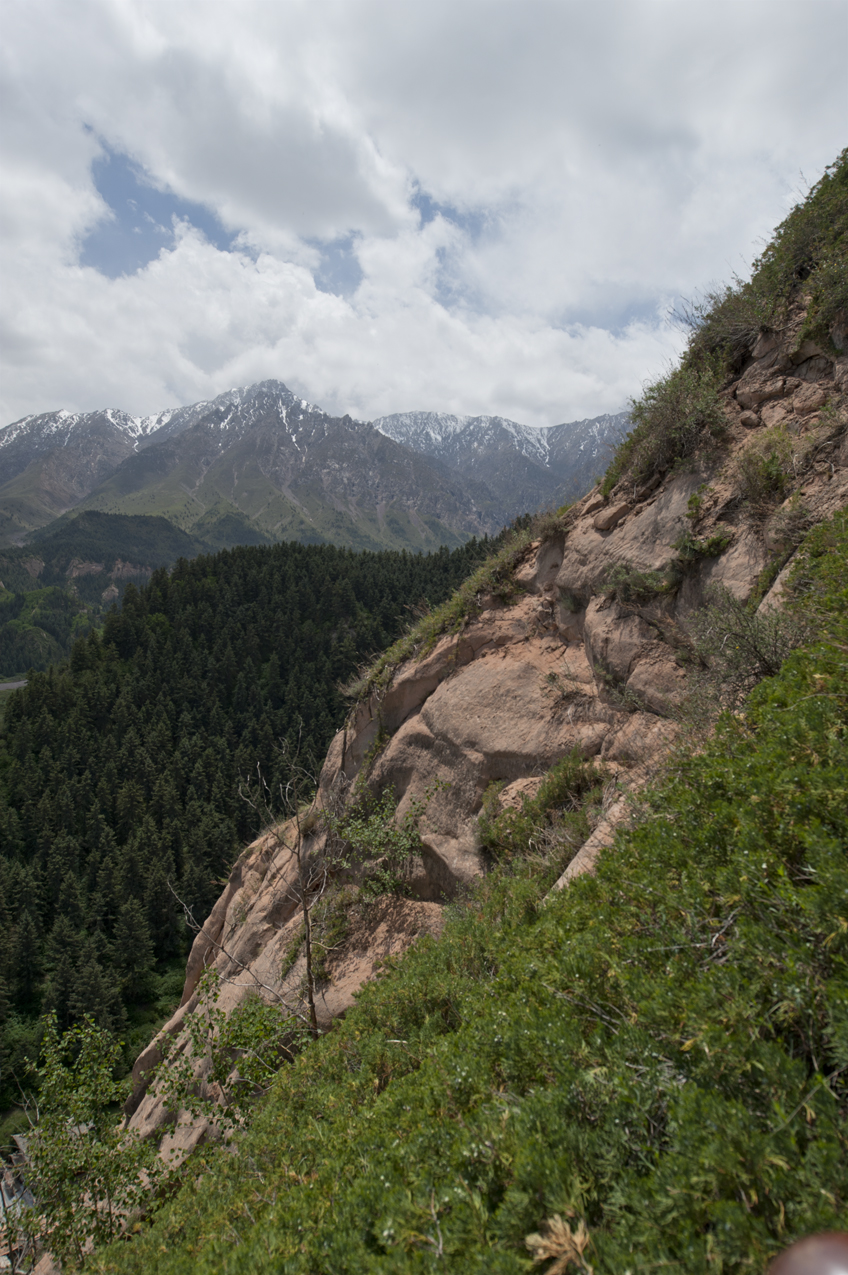
Somewhere in the distance is Zhangye. The nice thing about hiking in this climate, beyond the fact that you have a view at every step, is that it's pretty hard to get lost.

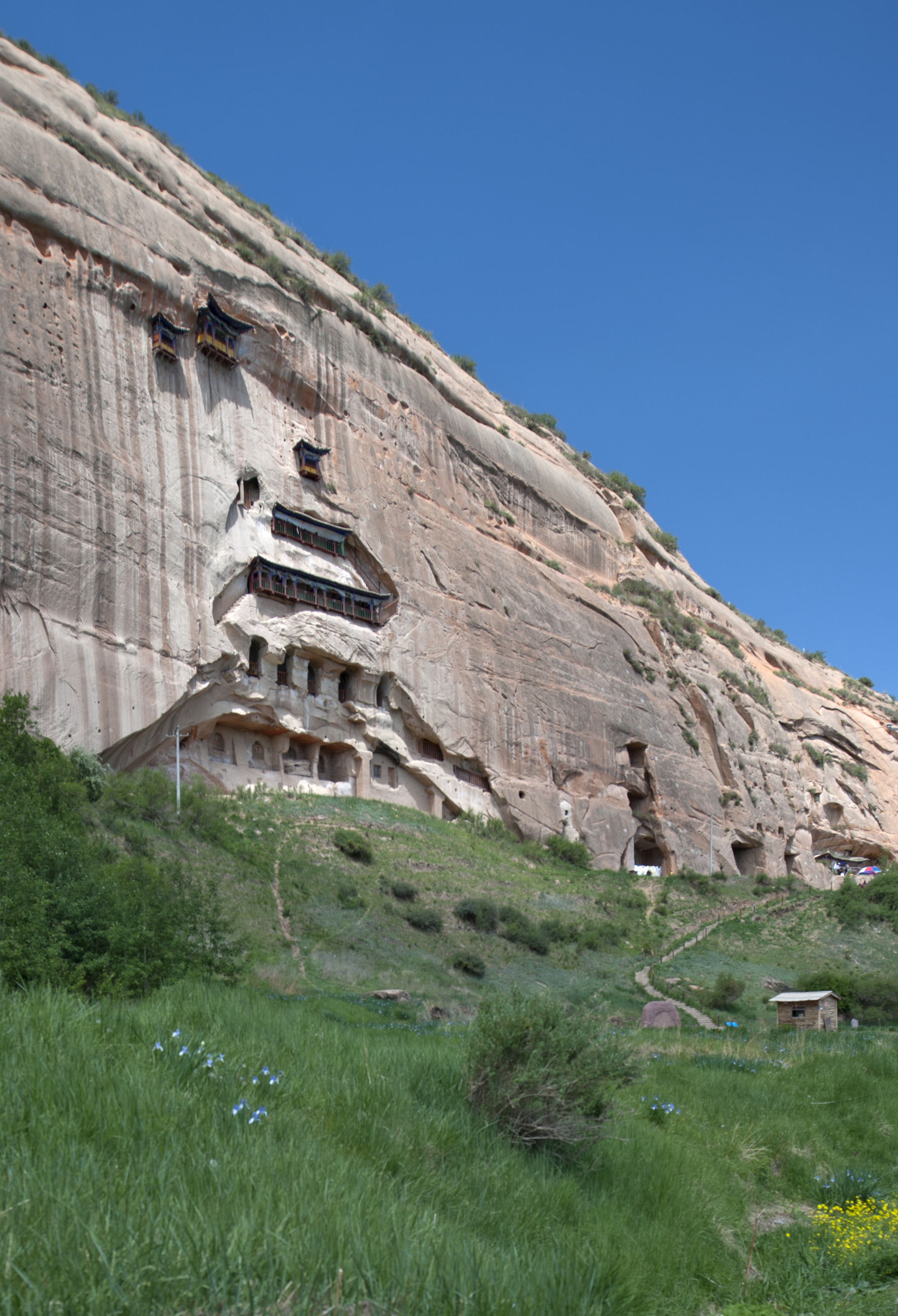
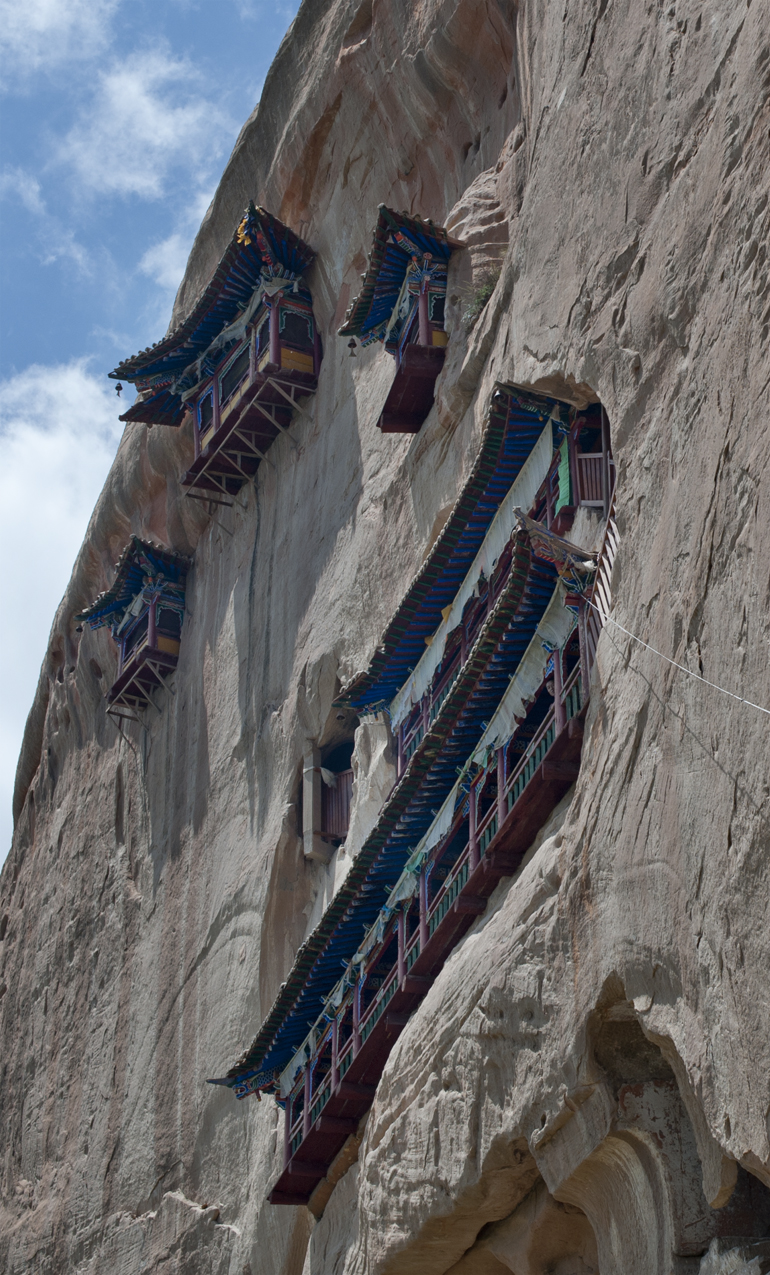
Built between 317 and 420, the temple consists of rooms that are scattered over seven stories, and connected by tunnel-like staircases and passages.

I discovered today that I'm claustrophobic. Climbing up through these narrow passages with four-foot ceilings and two-foot risers on my hands and knees was one of the most terrifying experiences of my life. It probably didn't help that once I got up to the rooms, with their generous 6-foot ceilings, they were filled with incense. I'm glad I made it up to the top without passing out. I was certainly out of breath and feeling more than a little dizzy. All I could think about after passing through each narrow passage was that I would have to do it again on the way down.

A quick moment for air while making the assent through the complex. You can make out the stupa in the background.

Alive at the base again

There are 1000 grottoes carved into these cliffs. At one time, they all contained Buddha statues.

On the other side of these mountains is the Tibetan Plateau.

This looks a little more rugged than New England.

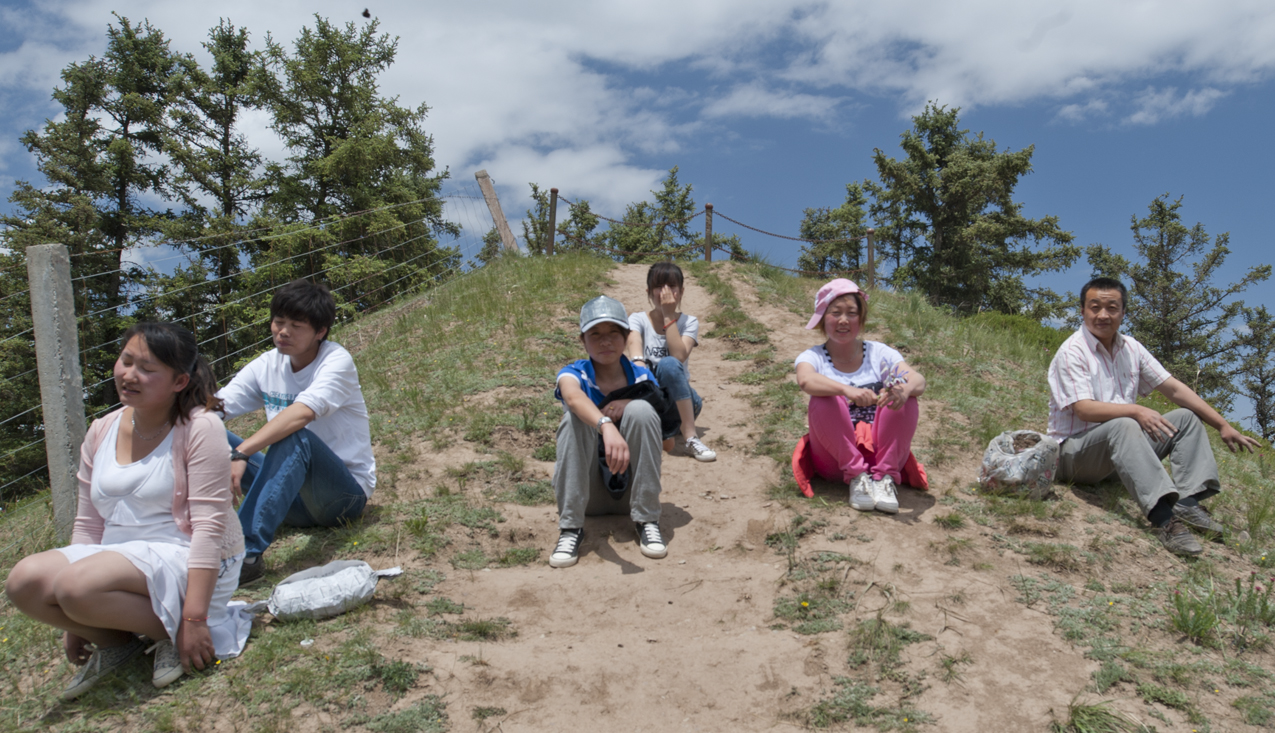
This was the most giddy family that I have ever met. They saw me sketching high on a ridge from below, and kept calling out to me, "Hallo! Hallo!" They then ran up the hill so that they could take pictures with me, laughing hysterically the whole time.

One of many rounds of family portraits that we had to go through. I wonder how many family albums will include photos of me when this trip is over. Shortly after this photo was taken, the man on the left lost his footing and slid about twenty feet down the mountain, much to the delight of his party.

The family soon found a "Sound of Music" photo op in a meadow of wild irises.

Here they are again, taking turns posing as the Buddha in some of the grottoes.

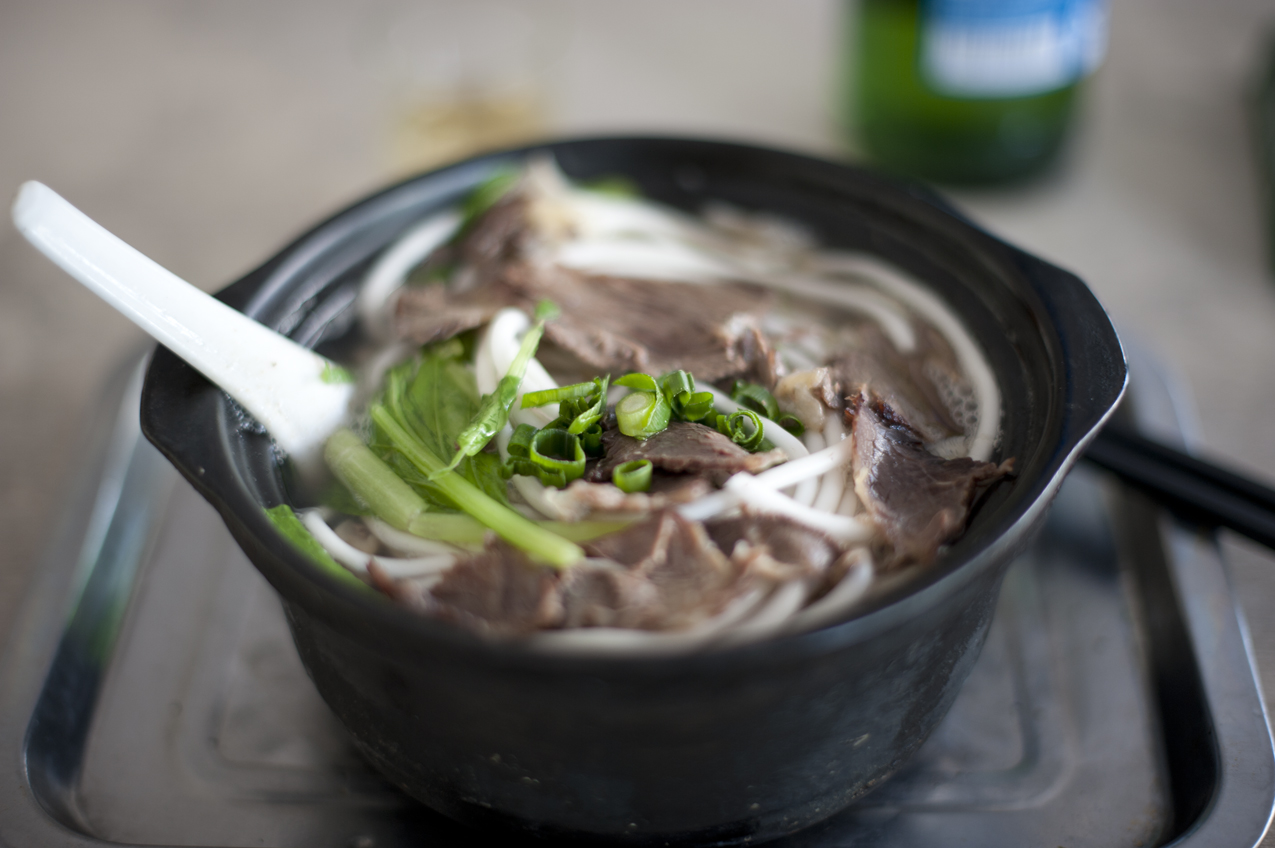
It's now becoming a tradition for me to post an image of my dinner. This was soup with noodles, some kind of meat, mushrooms, green onion, tofu, and chinese broccoli.

Back in the Swing of Things

If at some point in the future, I am given the opportunity to go back to Lanzhou, I think that I will politely decline.  Perhaps I was in a bad mood last night, but the “most polluted city in the world” did not leave me with pleasant memories.  The air gave me an asthma flair-up, and the night market was a complete disappointment.  However, I only spent one night there, and today was a great day.

I’m now in Zhangye (pronounced Jong-yeh), a much smaller city of about 300,000 people.  I took the train here this morning, and passed through some incredible landscape, including a section with towering snow-capped peaks in the distance, and rugged desert in the foreground.  Unfortunately, snapping photos out the window of a moving train does not yield good results, so you’ll have to use some imagination, and just believe me when I tell you that it was amazing.  While yesterday’s train was full of sleeper coaches, today’s only had Amtrak-style cars.  My car turned into a raucous get-together by the end of the trip.  There were kids running around, and climbing all over the seats, five different cell phones blasting Chinese pop music at full blast (competing with the traditional vocal music that was blasted over the loudspeakers), and even conductors who walked up and down the train trying to sell random goods (belts, toys, towels, and assorted other items).  I was also somewhat of an attraction and conversation piece in the crowded aisles.  Staring out the window when I could I was able to see my first camel of the trip (didn’t have the camera out), and caught a glimpse of the Great Wall (although as you’ll see in the image below, it didn’t look so great).

The weather upon arrival in Zhangye was absolutely perfect.  It’s dry here, and I’m able to sleep with the window open.  It’s the first time since arriving in China that I’ve felt smog-free.  I’m looking forward to getting out into the countryside to enjoy more of the weather tomorrow.  I’m planning on hiking around a Buddhist monastery that was built into the side of a cliff.  Then, I’ll spend one more night here before heading to jiayuguan, which is the next oasis along the Silk Road.  Marco Polo spent a year in Zhangye, but it looks like I’ll be out of here after two nights.

Here are a bunch of photos from the last two days (apologies for the blurry out-the-window shots):

Xi’an to Lanzhou:

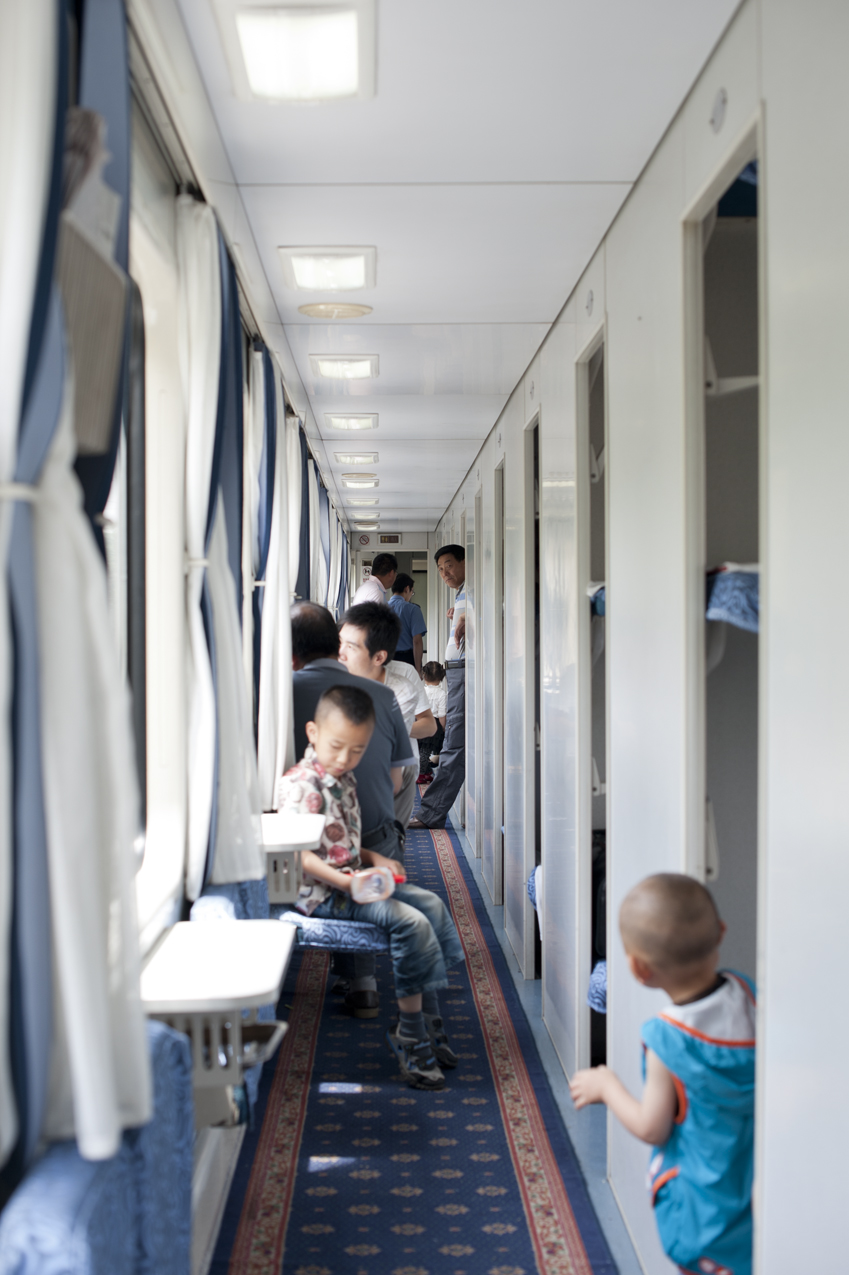
The busy corridor in the sleeper coach to Lanzhou

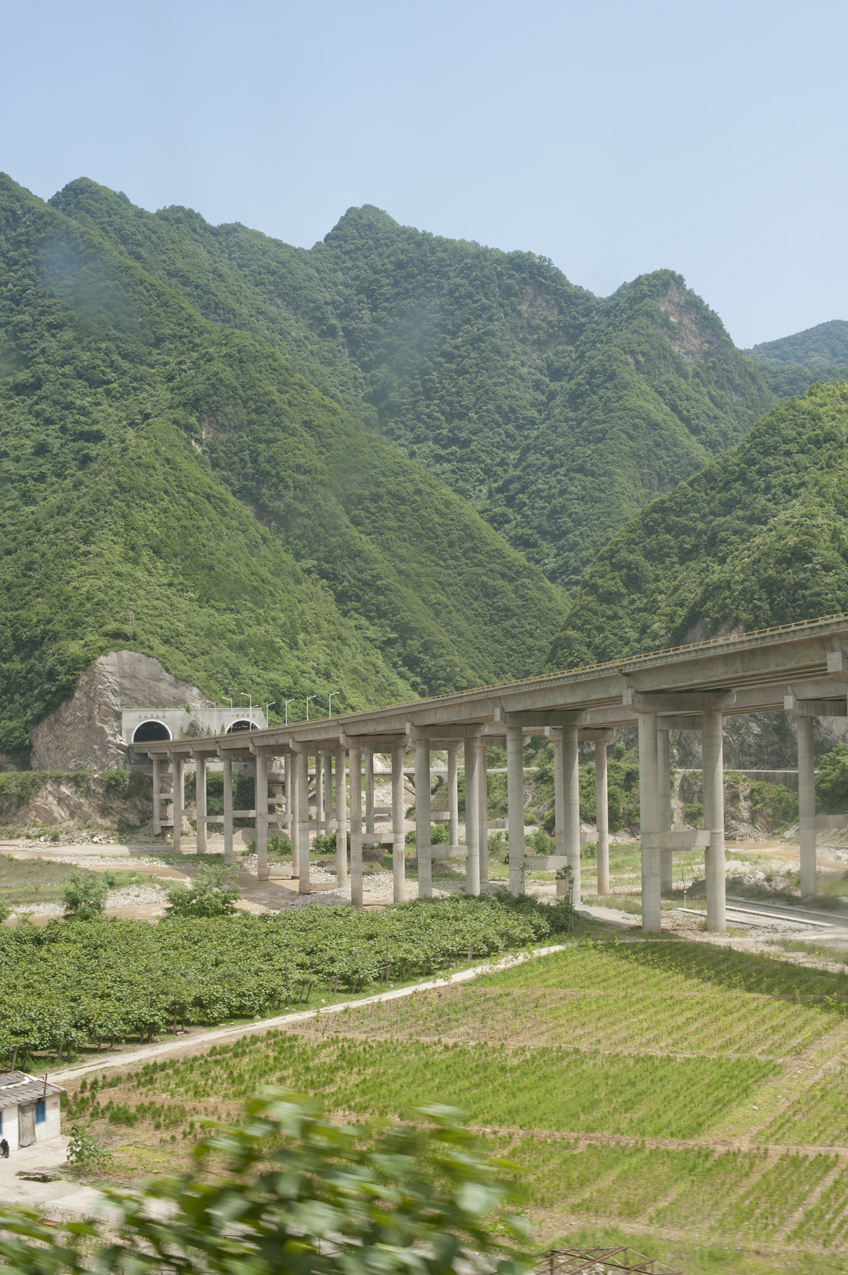
The lush greenery outside the train window

A transition towards a more arid climate

Lanzhou to Zhangye:

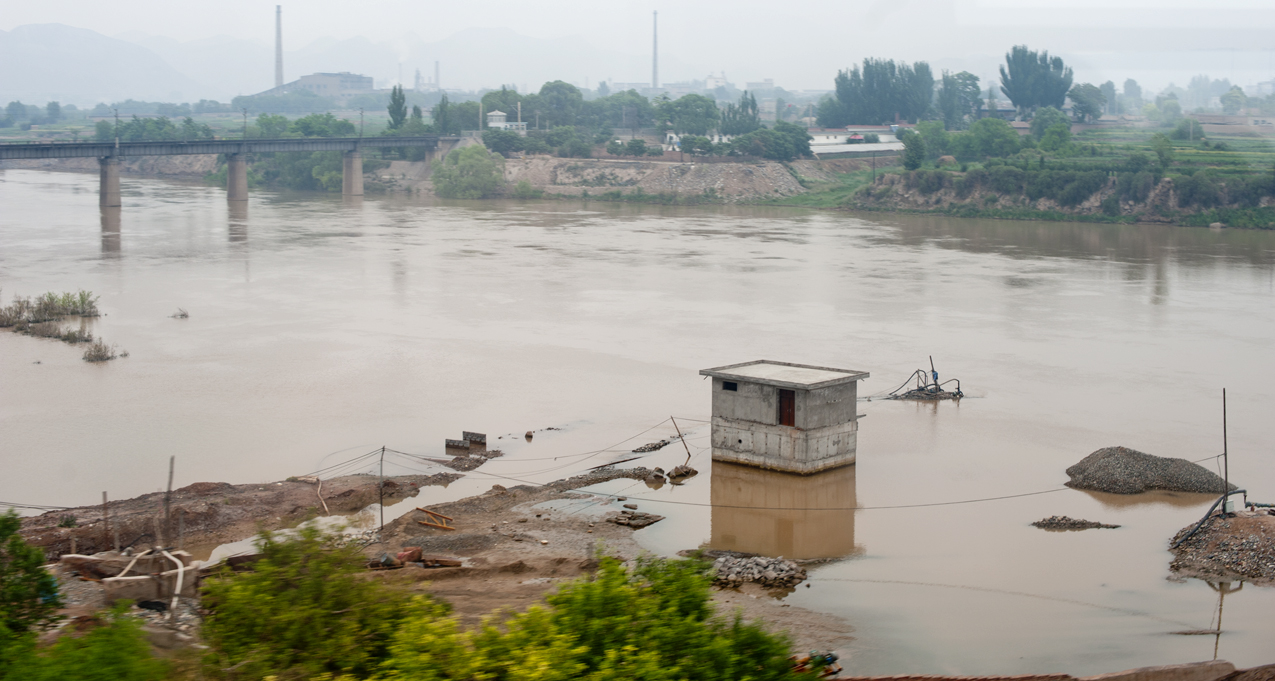
My only glimpse of the Yellow River, although it looks more brown to me.

I made a few friends on the train today. This little lady was the youngest of them.

A happy camper on the train today, and not just because she made a new friend. She just got a new ball! It was sold to her parents by one of the infomercial conductors.

This fellow sat in the seat in front of me, and kept turning around to stare at the foreigner. At one point, he engaged me in a long one-sided conversation about the meaning of life, although i understood absolutely nothing of what he said, which didn't seem to bother him. He also had fun pulling the blond hair on my arm.

The Gobi looms near.

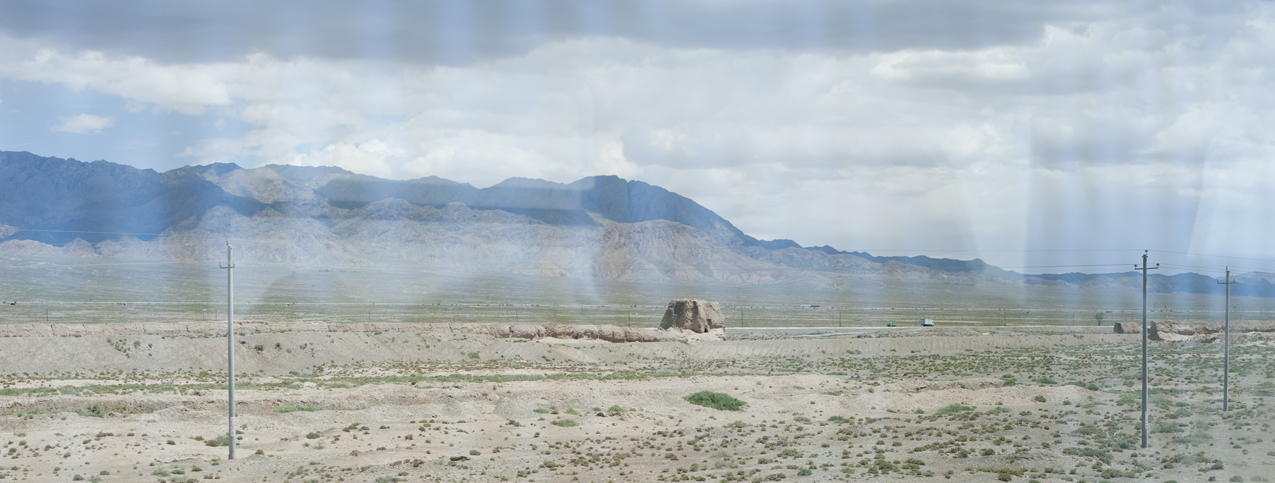
Believe it or not, this is the Great Wall of China, although it looks more like the Just OK Wall to me. That mound-like object is one of the guard towers. On the western fringes of the wall, they built it with rammed earth, and never got around to reinforcing it during the Ming period like they did with the more famous sections. I'll see more of this as I travel again on Saturday.

Zhangye:

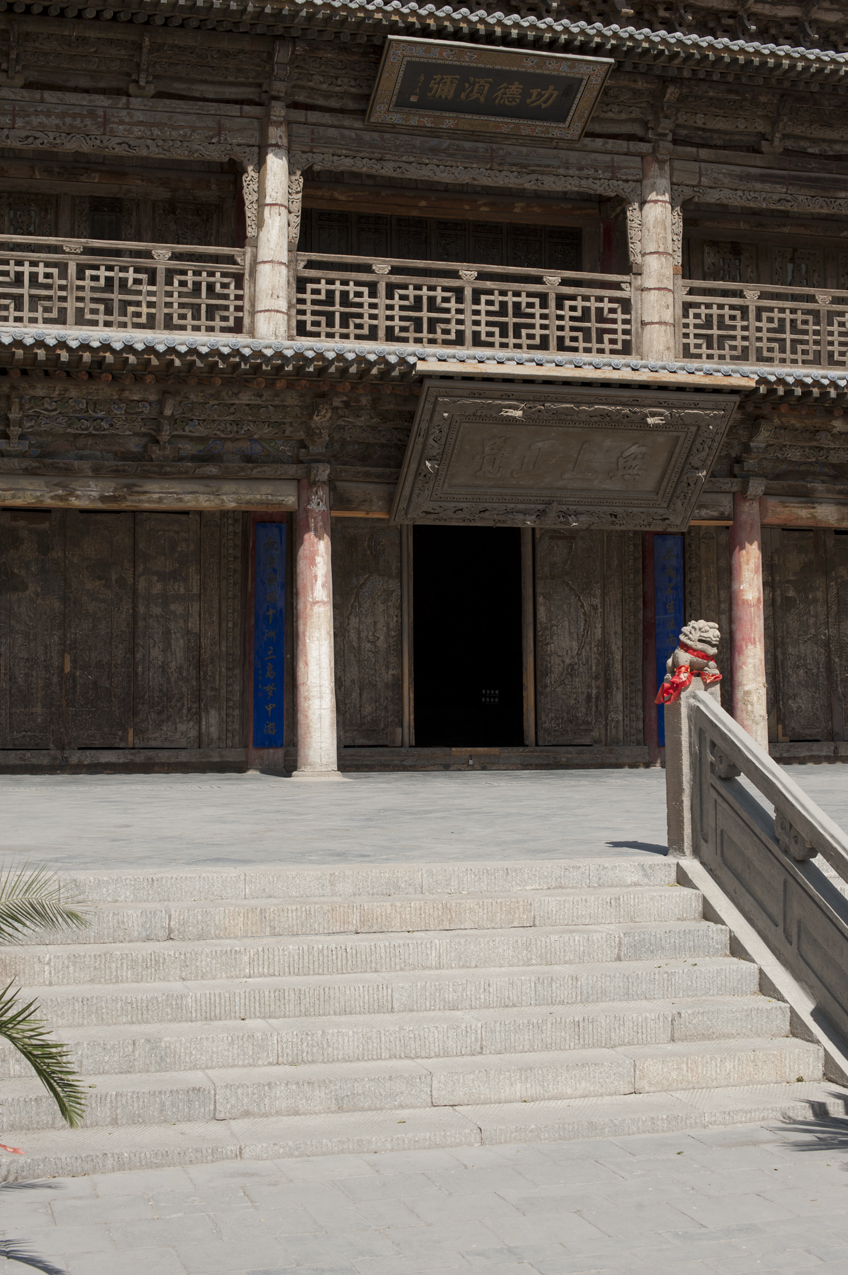
The Great Buddha Temple. Inside is a giant reclining Buddha, 140-feet long. He looks like he might be napping, but his eyes are slightly open, as though he's in deep thought. You'll have to take my word for it, though, since no photography is allowed inside.

The only Buddha that I was able to photograph. This one's on the side of the temple.

The huge stupa at the temple complex.

Supposedly, Kublai Khan was born in the Great Buddha Temple.

Evidently, China never had the great polychromy debate that raged in Europe in the 19th Century.

My dinner. I asked the waitress what she would recommend, and I wonder if she recommended this because it's what westerners always order there. It looked good, but every other dish at the restaurant looked better. The tablecloths were greener on the other tables, too.

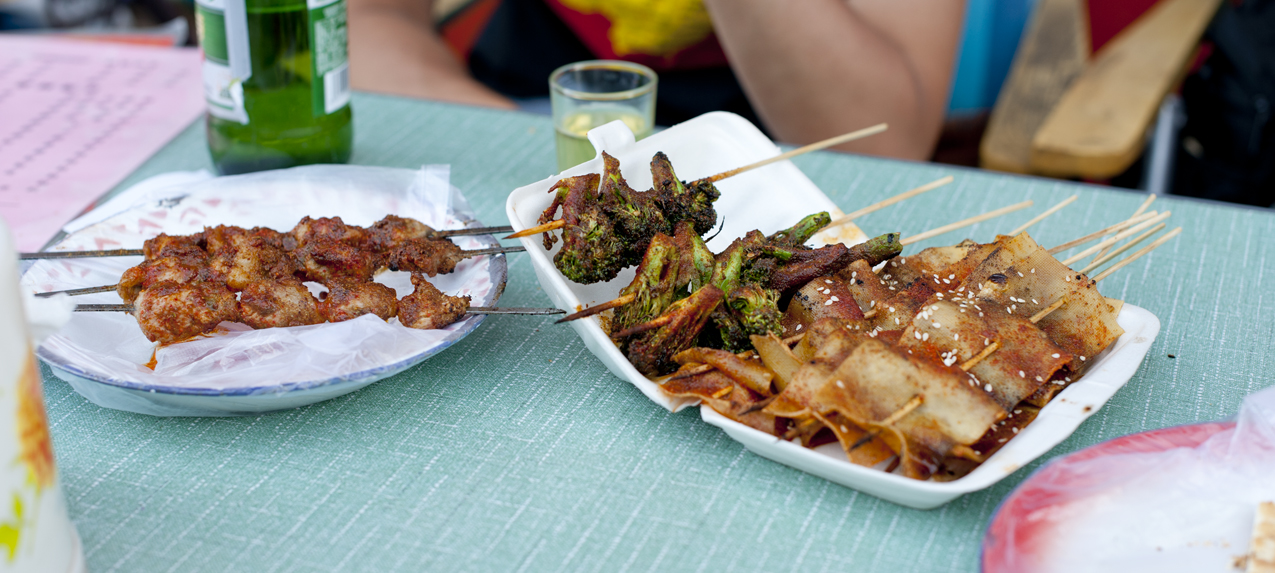
A snack. I don't know what the one on the left was, but it tasted pretty good. The little rollups were delicious. They were stuffed with cilantro and other greens. I don't know what the wrapper was, though. I'm assuming it was rice-based, but it didn't really have that consistency. Both were cooked over coals on the street, and were covered in a glorious mix of spices.